



 +86 18368240367
 Jasonhardware@foxmail.com

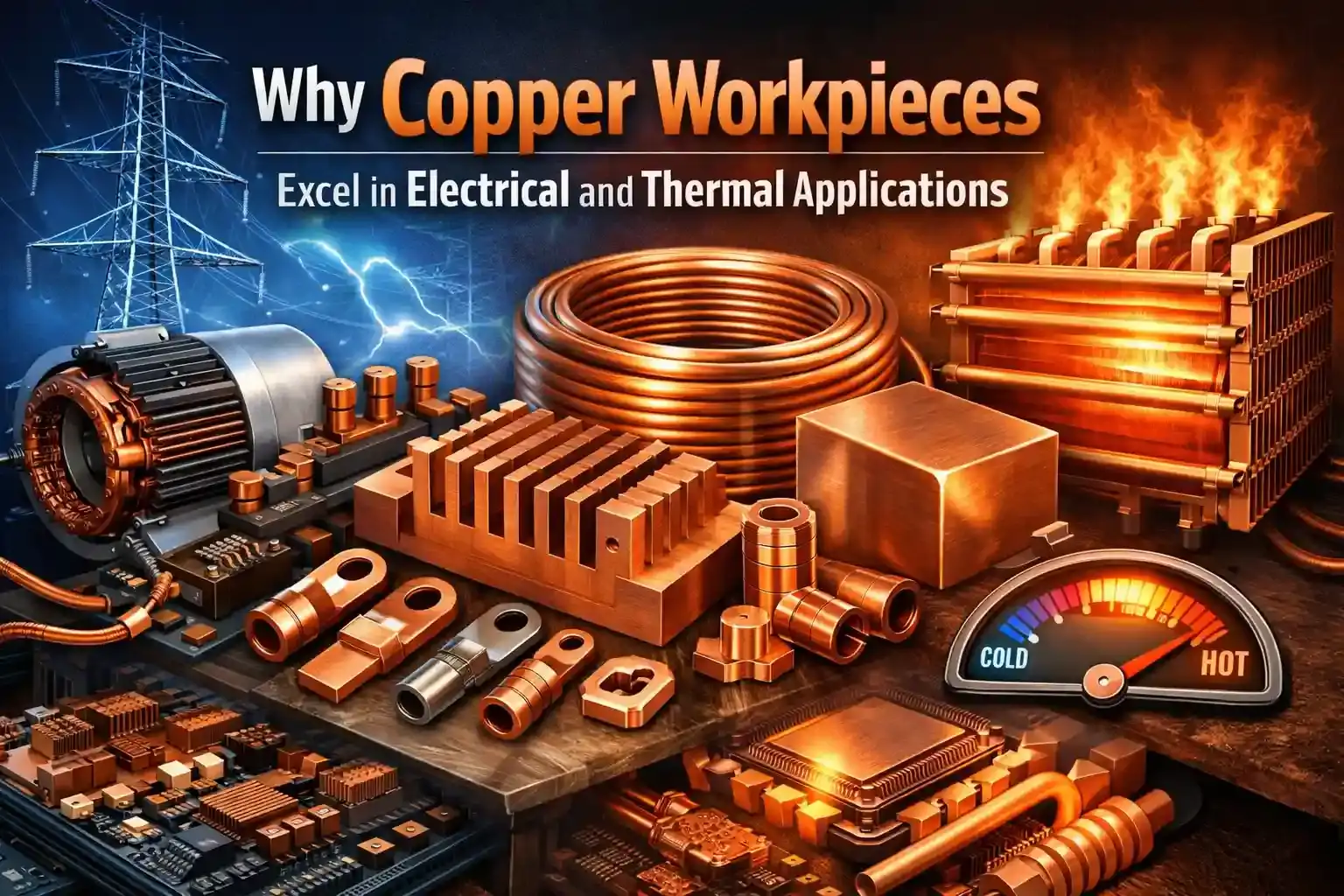
Copper is an excellent metal. It has been used for several years. Copper is the most accessible and affordable metal, unlike others that aren't as widely available. A copper workpiece is a key component in modern industry. It is used to drive machines and for heat transfer, and it is responsible for the system's smooth operation.
The article describes copper's properties that make it ideal for electrical and thermal applications and explains why custom copper parts are increasingly used in industry.
Copper can be easily shaped. It bends without breaking. It has a higher electrical and thermal conductivity than most metals. It is also extremely corrosion-resistant and will withstand harsh environments for extended periods.
These properties go well beyond what one expects. That is precisely why copper is favored in the electrical and thermal fields.
It will take a conductor to move electricity. The smoother, the less energy loss. It is one of the most similar routes on the Copper. It is the second-best conductor of electricity after silver. The problem is that silver is too costly for use in everyday industries. Copper has excellent conductivity at a reasonable cost.
How Conductivity Works in a Copper Workpiece
The resistance of a copper workpiece will be least when there is an electric current flowing in it. The lower the resistance, the less heat the current produces. There's more energy when an object receives less heat. Copper is utilized for electric motors, transformers, busbars, connectors, and circuit boards. In all instances, its conductivity maintains the system efficient and dependable.
Why Other Metals Fall Short
In some instances, aluminum might be the only other alternative. Hence, it is less heavy and less costly. But the electrical conductivity of aluminum is some 60% of that of copper. Copper excels in high-performance applications, outperforming other materials. Sometimes, the replacement of copper is achieved with a larger, heavier part, which runs counter to the purpose.
Heat needs to move. In many systems, heat accumulation at a location causes damage. Copper is a good conductor of heat and transfers it efficiently. It has a high thermal conductivity, much higher than that of any other metal in use in industry.
Keeping Systems Cool
This is a very important property in electronics. Heat is produced in processors, power modules, and LED systems. This heat must be quickly removed, or it will lead to poorer performance and failures. A copper heat sink and heat spreader will remove heat from critical components and distribute it safely.
Copper is also present in radiators and cooling systems. Its fast heat transfer characteristics prevent overheating and ensure systems run longer in such cases.
Industrial Heating Applications
Copper has a role other than cooling. It is also employed in heating systems. Copper tubing and components are used in boilers, heat pipes, and underfloor heating systems. The metal distributes heat uniformly and withstands temperatures during heat and cool without adversely affecting it.
Each application requires its own specific requirements. A regular copper bar may be adequate for some tasks. However, if a dimension, shape, or performance requirement is critical, stock parts will not do. That's where copper custom parts really come in handy.
Custom parts are made to exact measurements. They are perfectly sized for the systems in which they are used. No modification, trimming, or adjustment required. This reduces assembly downtime and can mitigate errors and performance loss.
Copper is not confined to any particular industry. It is present in a variety of industries, all for slightly different reasons.
Electronics and Semiconductors
Copper is used in printed circuit boards, connectors, lead frames, and terminals. The metal conductivity helps in carrying the signals and energy smoothly and effectively. The trend of miniaturization and increasing power of electronic devices is growing, and so is the demand for precision custom copper parts.
Automotive and Electric Vehicles
These days, there are a lot of electrical systems in today's cars. Electric vehicles go even further, copper finds application in motors, battery contact, charging equipment, and wiring harness.
Refrigeration
Heating, ventilation, air conditioning, and refrigeration systems all use copper tubing and fittings. Copper's thermal characteristics make it effective at moving heat into and out of these systems.
Aerospace and Defense
Reliability cannot be compromised in the aerospace industry. Copper consumption applications include Avionics, Communications, and Thermal Management products. It performs reliably across temperature extremes and is suitable for sensitive applications.
Yes, and a practical one of copper is that it's one of them. Compared with steel or titanium, it is a soft metal. It can be easily drawn into very thin wires, rolled into flat sheets, and machined and bent cleanly and easily. Manufacturers can produce complex shapes with tight tolerances and minimize tool wear and waste.
The ability to process the material easily allows custom copper components to be fabricated quickly and at lower cost, even for complex designs that are difficult to process in harder materials.
Durability
Copper lasts. When exposed to air, it develops a protective coat known as patina. This layer is an actual protective barrier against further corrosion of the metal. Copper will not rust through and weaken as iron or steel will.
Long Service Life
The durability is such that, in proper environments, copper components have a lifespan of decades. In electrical systems, long service life minimizes replacement and maintenance costs. Copper pipes and fittings can endure for 50 years or more in plumbing and HVAC systems.
Works in Harsh Conditions
Copper is suitable in humid areas and industrial areas where moisture and chemicals are present. This makes it ideal for outdoor electrical installations, a marine setting, and chemical processing equipment.
Pure copper lubricant is fine, but sometimes it needs enhancement. Other metals are added to make copper alloys, which offer certain added advantages whilst preserving the effects of copper.
Brass (copper and zinc) is easier to cut. Bronze (coppers and tins) is hard. Each alloy serves a distinct function, offering the engineer even greater versatility when creating unique copper components.
The copper workpiece is not as simple as it sounds. It's an integral part of modern electric and heat engineering. It is difficult to replace because of its high conductivity and ease of cutting. Copper continues to work everywhere, which is why industries worldwide continue to depend on it.
1: Where Should I Buy Copper Workpieces in Bulk for My Retail Business?
The best way is to purchase your copper workpieces from a copper workpiece manufacturer or from a trusted industrial supplier.
2: How to purchase custom copper parts in bulk at reasonable rates?
Make direct contact with producers and ask for volume discounts.
3: Where to find a Copper Workpiece Supplier that offers Customization?
A good number of established copper parts manufacturers, particularly in China, India, and Germany, provide end-to-end customization service in addition to bulk production without relying on a third-party facility.
4: Do any Custom Copper Parts Suppliers offer Customization at competitive bulk quantities?
Several manufacturers from Asia and Eastern Europe supply bulk copper workpieces with customized specs at competitive rates.
5: How to Check the Quality of Copper Workpieces before Ordering in Bulk?
Request material certification confirming the grade and purity of the copper.
Among amateur metal machinists and engineers, ther
READ FULLElectrical applications demand high conductivity, and compromising o
READ FULL

Have a question or need a quote? Fill out this form and our team will get back to you quickly!