



 +86 18368240367
 Jasonhardware@foxmail.com

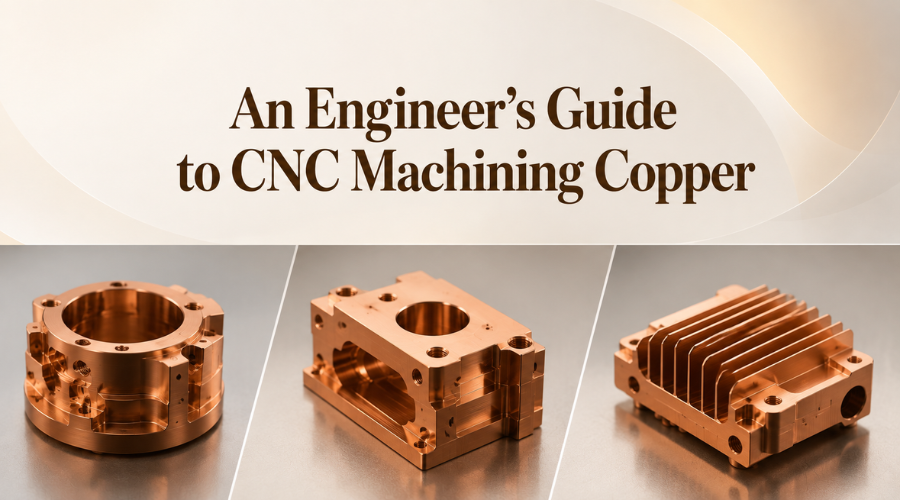
Among amateur metal machinists and engineers, there is a perception that copper material is easy to work with because it is soft and conductive. That perception is quite mistaken.
In reality, copper can be difficult to machine consistently. Its ductility can produce long chips, stubborn burrs, material smearing, and distortion in thin or delicate features. You may achieve a functional prototype with a basic process, but repeatable production requires more careful material selection, DFM planning, workholding, tooling, and inspection.
That is why choosing the right copper CNC machining supplier is the most important initial decision you can take from a manufacturing point of view. A capable supplier should not just blindly process your drawing. Instead, they should help you identify risks before the final product becomes scrap due to faulty machining or a production delay due to last-minute design changes.
In this blog, we tackle all the issues and manufacturing considerations that help engineers to produce reliable copper components. We will cover material choices, process considerations, surface treatments, and design rules.
Copper machining parts are custom components produced by removing material from copper stock through CNC milling, turning, drilling, reaming, tapping, and other secondary processes.
CNC machining is the right process when your part construction requires:
Controlled tolerances
Complex geometry
Accurate holes and threads
Prototype flexibility
Low-to-medium production volumes
Common examples of parts having the above features are electrical terminals, high-current connectors, busbars, heat sinks, thermal spreaders, welding electrodes, RF components, industrial fittings, and precision automation hardware.
Machining is especially valuable when your design cannot be produced economically through stamping or casting, or when you need to validate a design before committing to dedicated production tooling.
Copper is a popular metal for machining because it combines high electrical conductivity, high thermal conductivity, ductility, and corrosion resistance. These properties make it a practical choice when your component is to be used in electronic and electrical applications. In these applications current transfer with minimal heat dissipation is a must. And copper performs reliably in demanding operating environments.
For engineers, the material decision is rarely just about conductivity. You also need to consider:
Mechanical strength
Corrosion exposure
Joining method, including soldering, brazing, or welding
Surface-treatment needs
Part geometry and machining complexity
Production quantity and cost targets
Copper’s ductility is useful in service, but it also changes how you need to design for machining. A soft, ductile material can form long chips, roll material at edges, and deform when a thin feature is clamped too aggressively. Copper is excellent at moving energy. It is less enthusiastic about behaving like a rigid block of steel.
The word “copper” is not enough for a production drawing. Your selected grade affects all aspects of a part’s operational performance from conductivity, machining performance to joining behavior, cost, and inspection requirements.
|
Grade |
Best suited for |
Machining consideration |
|
C10100 |
High-purity electrical and thermal applications |
Prioritize when conductivity and purity are critical |
|
C11000 |
Busbars, terminals, electrical hardware, and general conductive parts |
Common choice for broadly specified electrical applications |
|
C14500 |
Precision parts requiring improved machinability |
Better chip control and production efficiency for complex components |
C10100, also known as oxygen-free electronic copper, is used where high purity and conductivity are key requirements. It contains at least 99.99% copper and is often considered for demanding electrical, electronic, vacuum, and joining applications.
C11000, or electrolytic tough-pitch copper, is a widely used grade for electrical and thermal components. It is often specified for busbars, terminals, connectors, and general conductive hardware.
C14500 is tellurium copper. It is designed to improve machinability while retaining useful conductivity, making it a practical choice for complex precision components, screw-machine parts, nozzles, and electrical hardware.
When preparing your drawing, specify the following clearly: UNS material grade, temper, applicable standard, and certification requirements. Submitting these requirements to a supplier prevents them from selecting a technically acceptable but functionally unsuitable alternative.
Copper machining problems often begin before the first tool touches the material.
Copper’s ductility can produce long, stringy chips. This causes poor chip evacuation. The stuck chips lead to recutting, surface damage, interrupted machining, and premature tool wear. The right tooling, cutting parameters, coolant strategy, and toolpath are essential to controlling this risk.
Burrs are especially important around threaded holes, drilled cross-holes, electrical contact surfaces, and thin edges. A vague note such as “deburr all edges” may not be sufficient for a functional copper part.
Instead, the engineering team should clearly define where sharp edges must remain sharp, where an edge break is acceptable, and where burrs could affect assembly, conductivity, or sealing.
Copper tends to stick to the cutting edge or smear across a finished surface. This can make the part visually unappealing and create variation in critical dimensions. Sharp tools and stable cutting conditions are what define the part as precision-manufactured.
Many copper parts have thin walls, fins, narrow webs, and delicate conductive features that distort under clamping pressure or cutting loads. As a manufacturing engineer, you should evaluate workholding before production to minimize the risk of distortion.
The right process depends on the part’s geometry, tolerances, volume, and functional requirements.
CNC milling is commonly used for pockets, slots, profiles, enclosures, thermal features, and precision flat components. It is useful when your part has multiple faces or complex milled geometry.
CNC turning is suited for the production of cylindrical parts such as pins, bushings, nozzles, threaded connectors, and concentric electrical hardware. As a product engineer, you should define runout, concentricity, thread requirements, and sealing surfaces clearly for superb parts quality.
Drilling, reaming, and tapping create holes for mounting, assembly, fluid paths, and electrical interfaces. For these features, the procurement professionals should specify for burr removal, blind-hole depth, thread engagement, and inspection access.
Multi-axis machining can reduce setup time for complex parts. However, this CNC machining process should be used where it improves precision or reduces handling risk. A complicated toolpath is not automatically a better toolpath if the part to be made is simple.
Surface treatments of copper parts are done to enhance the corrosion resistance, solderability, contact performance, dimensional fit, and visual appearance. There are several surface treatments like
Mechanical finishing can involve multiple finishing processes like deburring, brushing, polishing, or controlled blasting. As a result of these processes the final machined part does not have sharp edges which reduces injury risk during handling. However, care should be taken to ensure that these treatments do not compromise a critical electrical-contact area or a tightly controlled surface.
Plating is often specified when your component needs improved corrosion resistance, solderability, wear resistance, or contact reliability. Depending on the application, engineers may specify tin, nickel, silver, gold, or another finish.
For CNC machined copper parts,product engineers should include these details in the drawing or specification:
Finish and plating material
Coating thickness
Masked or unplated areas
Surface roughness requirements
Post-plating dimensional limits
Adhesion or performance testing requirements
Packaging requirements for parts safety.
Avoid applying a surface-finish requirement across the entire part unless every surface needs it. Focus requirements on the features that affect function, or assembly.
Copper components are some of the most versatile and are best utilized in industries where conductivity and thermal performance directly affect product reliability and performance.
In electrical and power systems, you may find copper in terminals, busbars, connectors, switchgear components, charging hardware, and high-current distribution assemblies.
In electronics and thermal management, copper is used for heat sinks, thermal spreaders, RF hardware, and high-performance electronic assemblies.
In industrial equipment, common uses of copper components include welding electrodes, fluid-handling components, automated moving parts etc.
Strong design for manufacturability reduces unnecessary cost and helps your supplier make the part correctly on the first production run.
Specify the exact copper grade and temper.
Apply close tolerances only on surfaces where functionality of the part will be affected.
Use realistic internal corner radii.
Avoid unnecessarily deep and narrow pockets.
Review thin walls and fine features early.
Define deburring and edge-break requirements.
Plan for surface finishing before finalizing dimensions.
Provide complete production documentation.
As an engineer, yuor job is to share a controlled 2D drawing, 3D CAD model, revision history, projected volume, inspection requirements, material certificates, and packaging expectations.
The earlier you resolve these details, the fewer surprises you create during quoting, first-article inspection, and ramp-up.
During prototyping, your focus should be to ensure that the part meets the material grade, functional dimensions, fit, electrical and thermal requirements, along with finishing compatibility. A prototype should answer the questions that matter most before volume production starts.
For repeat production, the main goal is consistency in parts quality. The CNC machining engineers working on high volume projects should establish stable workholding, clear inspection points, controlled deburring, and traceable documentation for uniform quality in batches.
A suitable copper CNC parts manufacturer should bring more than machining capacity for their expertise. You need a partner that can clarify requirements, manage production risk, and provide documentation appropriate for your application.
Renjiu specializes in precision hardware-part processing and automated-equipment manufacturing. We have a competent and dedicated engineering team that delivers all types of custom processing based on customer drawings and samples. We serve international customers with a stated focus on quality control and efficient service.
Copper can deliver fantastic electrical and thermal performance, but the material demands a higher CNC engineering expertise than machining a conventional metal or alloy.
Machining success depends on choosing the correct grade, designing for chip control, deburring, workholding, and finishing. Apply tolerances where they serve a real function. Then engage a qualified copper CNC machining supplier before your design is locked.
For custom CNC machined copper parts, submission of a 2D drawing or 3D CAD model is a must along with material specification, expected quantity, and inspection requirements.
FAQs
Why use copper for precision machined parts?
Copper is a favorite because it carries electricity and heat better than most metals. That makes it perfect for things like connectors, heat exchangers, and RF components. Plus, it resists corrosion and has a clean, polished look.
What makes copper tricky to CNC machine?
Copper is soft and tends to stick to cutting tools. Instead of producing neat chips, it can smear, which wears tools down faster and generates heat. Machinists usually slow things down, keep tools extra sharp, and use cooling to get cleanly shaped parts.
Where are CNC machined copper parts used?
What drawings and files are needed for copper machining?
Shops typically want 2D drawings (PDF/DWG) with tolerances and finishes, plus 3D CAD files (STEP/IGES) for programming. You also need to provide clear notes on material grade, dimensions, and any surface treatments.
Among amateur metal machinists and engineers, ther
READ FULLElectrical applications demand high conductivity, and compromising o
READ FULL

Have a question or need a quote? Fill out this form and our team will get back to you quickly!