



 +86 18368240367
 Jasonhardware@foxmail.com

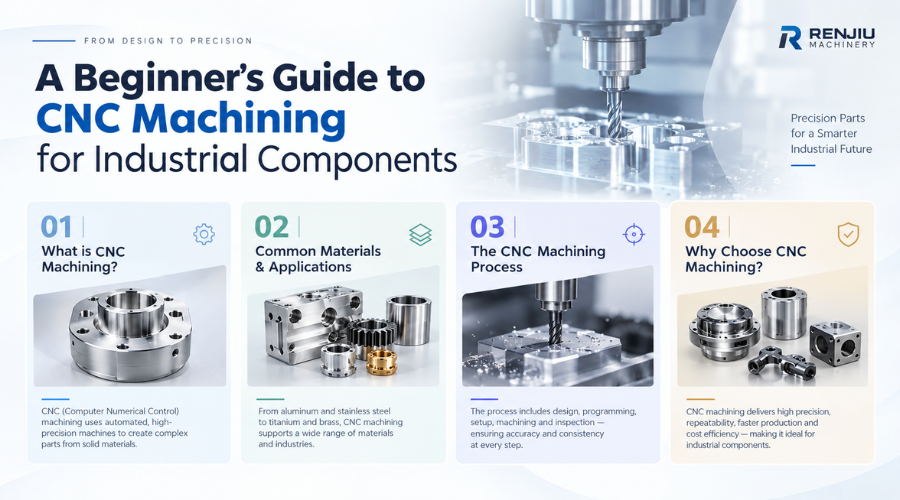
Starting a CNC machining business looks straightforward from the outside. You buy a machine, hire an operator, and produce parts. In reality, building a dependable machining operation requires much more than owning equipment.
You need to invest in machines, tooling, materials, software, staff, inspection equipment. Only if you have all this you can say you have a dependable order pipeline. That makes your early decisions crucial.
CNC machining uses computer-controlled tools to remove material from a workpiece according to programmed instructions. The process can produce highly accurate industrial components, but your results depend on how well you plan the entire operation.
Even if you plan to become a Custom CNC Machined Parts Supplier, you first need to understand how machining choices affect cost, capacity, and repeatability.
This guide walks you through the process, equipment, materials, setup decisions, quality control, quoting, and scaling considerations you need to understand before you commit serious capital.
CNC machining is a subtractive manufacturing process in which computer-controlled equipment removes material from a raw material piece to create the required shape and geometry according to specific dimensions.
The operator uploads the machine with programmed instructions. The CNC system then controls movements such as tool position, cutting speed, feed rate, and cutting operations according to the programmed instructions uploaded by operator
This is different from manual machining, where the operator controls the machine more directly. It is also different from additive manufacturing, where material is built up layer by layer rather than removed from a larger workpiece.
Common CNC equipment includes CNC milling machines, CNC lathes, and multi-axis machining centers.
But here it is important to remember that the finished product quality does not depend entirely on machine specifications. Tooling, workholding, CAM software, measurement equipment, programming skill, and operator experience all affect the final product.
Your first major decision is understanding which machining processes your target customers actually need.
CNC milling uses rotating cutting tools to remove material from a workpiece. The workpiece which is to be cut either remains fixed or moves during the machining process depending on the CNC machine type and setup.
CNC Milling is the most common machining process for manufacturing components such as housings, brackets, plates etc. It is capable of producing parts with complex pockets, slots, holes, and other features.
In CNC milling the number of machine axes and setup is one of the most important aspect to confirm before production starts.
A simple component will require one setup. A more complex part may need to be positioned and setup multiple times. If you want to avoid mutiple setups, alternative is to use a multi-axis machining center. Every additional setup affects machining time, accuracy, labor, and cost.
That means you should not simply ask, "Can my machine make this part?" Ask whether your machine can make it efficiently and repeatedly.
Turning is a different process than milling. The workpiece rotates while a cutting tool removes material.
This process is best suited for round components production such as shafts, pins, bushings. If your target market regularly purchases cylindrical components, turning becomes a crucial part of your production capability.
Many parts require both milling and turning. In such cases mill-turn equipment is excellent machinery choice as it combines turning and milling operations in one machine. That can reduce the need to move a part between machines. The downside is higher equipment costs and more specialized programming requirements.
Industrial components often need more than basic milling or turning. Many parts require additional design features like drilled holes, cut threads, deburr edges, or surface treatments.
As a CNC parts manufacturer or supplier, it is necessary to perform every operation inhouse. That is fine. What matters is that you include those requirements in your quotation and production plan from the beginning for your clients.
Material selection affects far more than the appearance of a finished component. Common CNC materials for parts production are usually aluminum, stainless steel, carbon steel, brass, titanium, and various synthetic plastics. Each behaves differently during machining process.
The material you choose has an impact machinability and tool wear, and total cost of your entire operation. So assuming there is a universal "best" material is a mistake.
Instead, you need to ask what the component actually has to withstand.
Will it face heat, corrosion, mechanical stress, repeated movement, or demanding operating conditions? Those requirements will ultimately determine quality of finished product. Once you are certain of this only then look closely at the design.
A client's drawing may look perfectly reasonable on screen. That does not mean it will cost-efficient to machine it.
Tight tolerances, and parts geometry along with demanding surface-finish requirements can substantially increase machining difficulty. This is where design for manufacturability, or DFM review becomes crucial.
As a custom CNC machined parts supplier, you need to review the drawing and 3D model early. Do not wait until production has started to discover that a feature requires an expensive setup or specialized tooling.
You should also question every tight tolerance.
Your goal is not just to produce an accurate part. Your goal is to produce the right level of accuracy at a commercially sensible cost.
Parts quality cannot be something you check only after production is finished.
You should build inspection into the machining process from the start.
Every inspection process begins with a drawing review. Follow that with a triple layer inspection process. That includes first-article inspection, in-process checks, and final inspection as appropriate for the part and customer requirement.
Your measurement equipment for inspection may include calipers, micrometers, height gauges, and coordinate measuring machines, commonly called CMMs. But keep in mind that not every part needs the same inspection approach.
The inspection method should match the feature, tolerance, and customer's requirements. A simple dimension may require a different measurement method from a complex geometric tolerance.
Documentation matters just as much.
Maintain revision-controlled drawings, inspection records, material certifications when required, and nonconformance records. These documents help you establish what was produced, against which requirements, and what happened when something went wrong.
Requirements vary by customer and industry. So do not claim a certification, compliance status, or quality capability that you cannot support with evidence.
For a new manufacturer, genuine quality control builds confidence. It also helps you identify the cause of defects instead of repeatedly fixing symptoms.
Your quotation needs to reflect the entire production route.
Common cost drivers include:
Do not forget setup time simply because the machine spends only a short period cutting the part. For a small production run, setup and programming costs can have a significant effect on the unit price.
The same applies to volume. A prototype order and a repeat production run do not necessarily have the same cost structure. When a customer asks for Bulk CNC Components, the opportunity may look profitable because larger quantities reduce per unit manufacturing costs.
But larger quantities create another challenge: can you actually deliver them consistently?
Bulk production requires that you have adequate capacity, process control, and material availability. It is not just about offering a lower unit price.
Before sending a quote, make sure to document your assumptions. Include the drawing revision, material, tolerances, surface finish, quantity, inspection scope, and delivery schedule.
You simply cannot expect to quote accurately when critical specifications are still unclear.
Review the complete specification and production route before promising price or lead time. That discipline protects your margin and your reputation.
Starting a CNC machining business is not simply a machine-buying exercise. You are building a production system that combines multiple elements like equipment, programming, material knowledge, and inspection.
So, define your target market before you make major equipment investments. Make sure your machine capabilities match the parts you intend to produce and the industrial sector you intend to serve. Review designs for manufacturability, estimate every meaningful cost, and document your quality processes. Do not let a premium machine or a promising customer request fool you into skipping the basics.
Choosing a titanium alloy is not simply a matter of selecting the st
READ FULLCNC Milling Parts supplier, wholesale CNC Milling Parts
READ FULLAmong amateur metal machinists and engineers, ther
READ FULL

Have a question or need a quote? Fill out this form and our team will get back to you quickly!