



 +86 18368240367
 Jasonhardware@foxmail.com

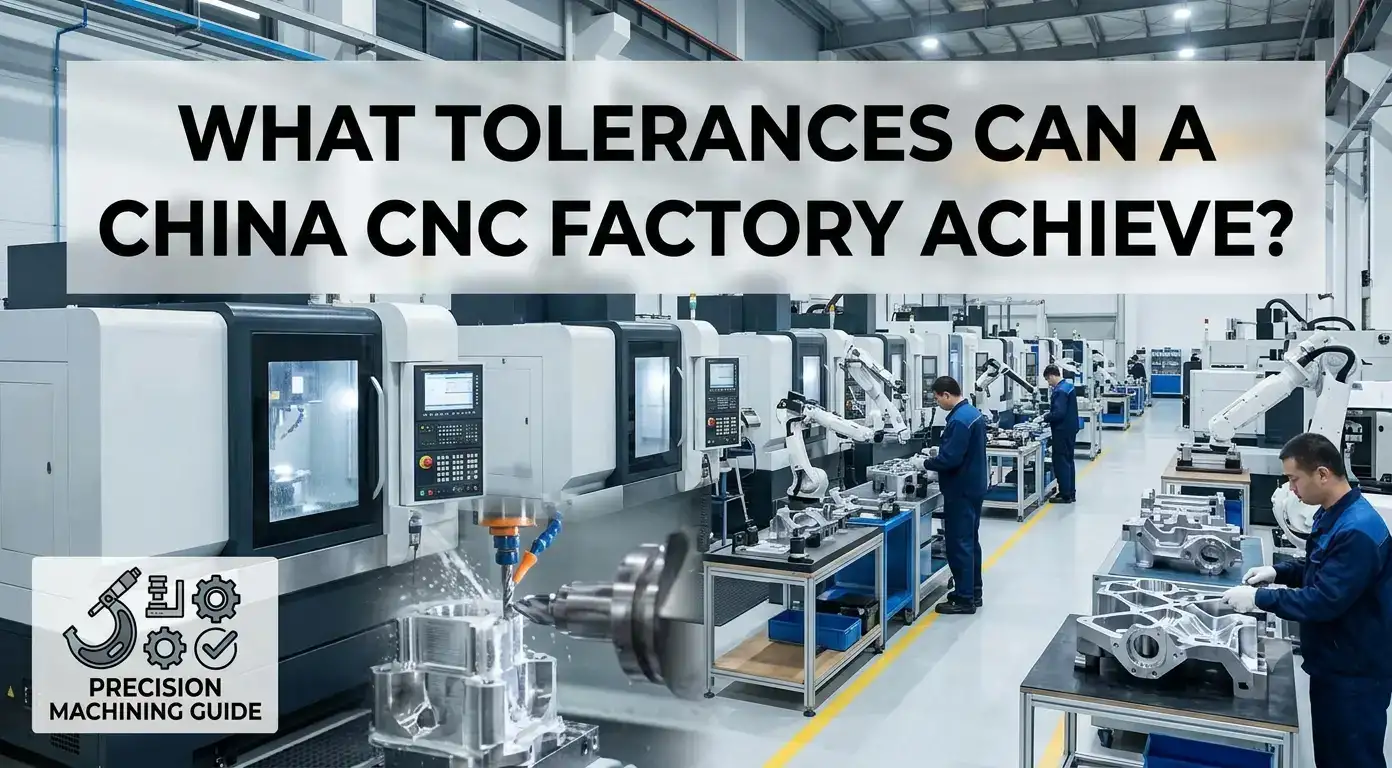
There is no doubt that China has almost taken over every industry, except for a few. It has over 70% share in the global supply of finished goods. Only if we look at the CNC parts industry, China has more advantages over its competitors because of having similar quality at a low cost. This is why we will discuss CNC tolerances China in this blog. We will discuss every main factor that affects the production cost, quality, and quantity. The biggest factor is tolerance in CNC machining, which directly affects the cost, time, and quality of production. You will get a better understanding in this blog once you find out about the tolerance factor and Chinese dominance in the industry.
Usually, most CNC parts require standard tolerance because it is cost-effective and faster. The production cost and time are less in standard designs than in complex ones. If we talk about CNC tolerances in China, it has a similar quality to European, American, and Japanese production. What makes it different from them is its lower cost.
The standard tolerance in Chinese CNC machining is ±0.005 inches. Many parts require basic machining and standard tolerance for production. This tolerance can reach ±0.001 inches if parts require slightly more complex designs. What’s important here is the wide range of tolerance offered by Chinese CNC machining companies. They provide an extensive solution to clients from different industries. Many automotive, aerospace, machinery, and medical parts require simple designs with standard tolerances.
Then there are some parts that have very complex designs, and that means they need challenging tolerances. CNC machines have to show intense machining precision to keep the tolerance very tight. When it comes to challenging tolerance, Chinese manufacturers can reach even ±0.0005 inches of tolerance. Such CNC tolerances in China include various factors like flatness, perpendicularity, roundness, etc.
These factors make it challenging for a manufacturer to maintain strict tolerance. The biggest risk in strict tolerance is of deformity and fracture of the part. The time and cost are also high in tight tolerances. Therefore, Chinese manufacturers work on small or medium-sized production when dealing with tight tolerances.
The CMM (Coordinate measuring machine) does the GD&T (Geometric Dimensioning and Tolerancing). Complex parts require more measurement and CMM inspection compared to simple parts. This method helps Chinese manufacturers to keep track of precision by frequently measuring the dimensions of parts.
In CNC tolerances China, CMM works on three axes, X, Y, and Z. In this process, it measures the geometry and physical dimensions of components. Chinese CNC factories ensure the entire production goes as per the plan through stage-wise CMM inspection.
Yes, Chinese CNC machining factories follow the FAI process. It is the initial step before full-scale production. It inspects if the parts are meeting the requirements of the clients or not. It is like a sample part that has to match every dimension and feature a client wants in the desired product.
The FAI process provides a clear picture of the finished appearance of a part before a manufacturer starts large-scale production. Clients get a clear view of the part to see the precision level. It helps the manufacturers to prevent dimensional and other types of errors in large-scale production.
Also, there is a ballooning drawing method where each specific point is highlighted in a circle or balloon shape with a number mentioned in it. For instance, there is a mechanical part that has different dimensions; an engineer will make a drawing and highlight each part by marking it in circles. Each circle will have a number in it to represent its designated details.
Chinese factories follow ISO 2768, ISO 286, and ASME Y14.5 standards for geometric dimension and tolerance. These standards help manufacturers to comply with international rules regarding CNC machining. The dimensions and tolerance have to be precise, and they have to match the safety levels. Too tight tolerance is not only very costly for the manufacturer, but it also poses a risk of deformity. That means Chinese factories provide a low-cost solution to global buyers along with strict quality compliance.
Tolerance in CNC machining is very crucial because it directly affects the cost, time, and quality of production. You can say that it is one of the pillars of CNC machining. Chinese industries also have to follow the global standards to match the requirements of worldwide buyers. Aerospace, automotive, machinery, and various industries need a CNC parts manufacturer to be precise in it. Too tight a tolerance can be problematic for the manufacturer sometimes, and too little tolerance can not work on complex parts. So, there has to be a middle ground between them. Chinese manufacturers have to be precise in it, along with maintaining a low cost of production.
What is the Tolerance Range of a Chinese CNC Factory?
The tolerance range of a Chinese factory is usually between ±0.005 and ±0.0005. It all depends on the complexity of the part because simple parts require low tolerance and complex parts require tight tolerance. If someone is about to choose a Chinese manufacturer, it is better to choose a reliable one that has a wide range of customization.
Where Can I Find a Tight Tolerance of CNC Machining for Complex Designs?
There are many ways to find CNC machining services with tight tolerances for complex designs. You can try B2B platforms like Made-in-China.com, Alibaba.com, and Tradewheel.com. Ningbo Renjiu Machinery Co., Ltd. is also a good option depending on your requirements.
Do Chinese CNC Factories Provide Better CNC Machining Results?
Well, we can not say that only Chinese factories provide better CNC machining results. There are many factors and global manufacturers who offer high precision in CNC machining. However, Chinese manufacturers have the advantage of maintaining low cost. In this way, they are usually more affordable with similar quality to others.
What Standards Do CNC Machining Factories Follow in Strict Quality Control?
CNC machining factories follow standards like ISO 2768, ISO 286, and ASME Y14.5 mostly. These quality standards provide high compliance with global quality rules.
If you source precision
READ FULLIf you’ve ever opened a quote for a titanium part and felt shocked to see the excessive pri
READ FULLEvery day, procurement teams across various industries like aerospace, medical devices, and indus
READ FULL

Have a question or need a quote? Fill out this form and our team will get back to you quickly!