



 +86 18368240367
 Jasonhardware@foxmail.com

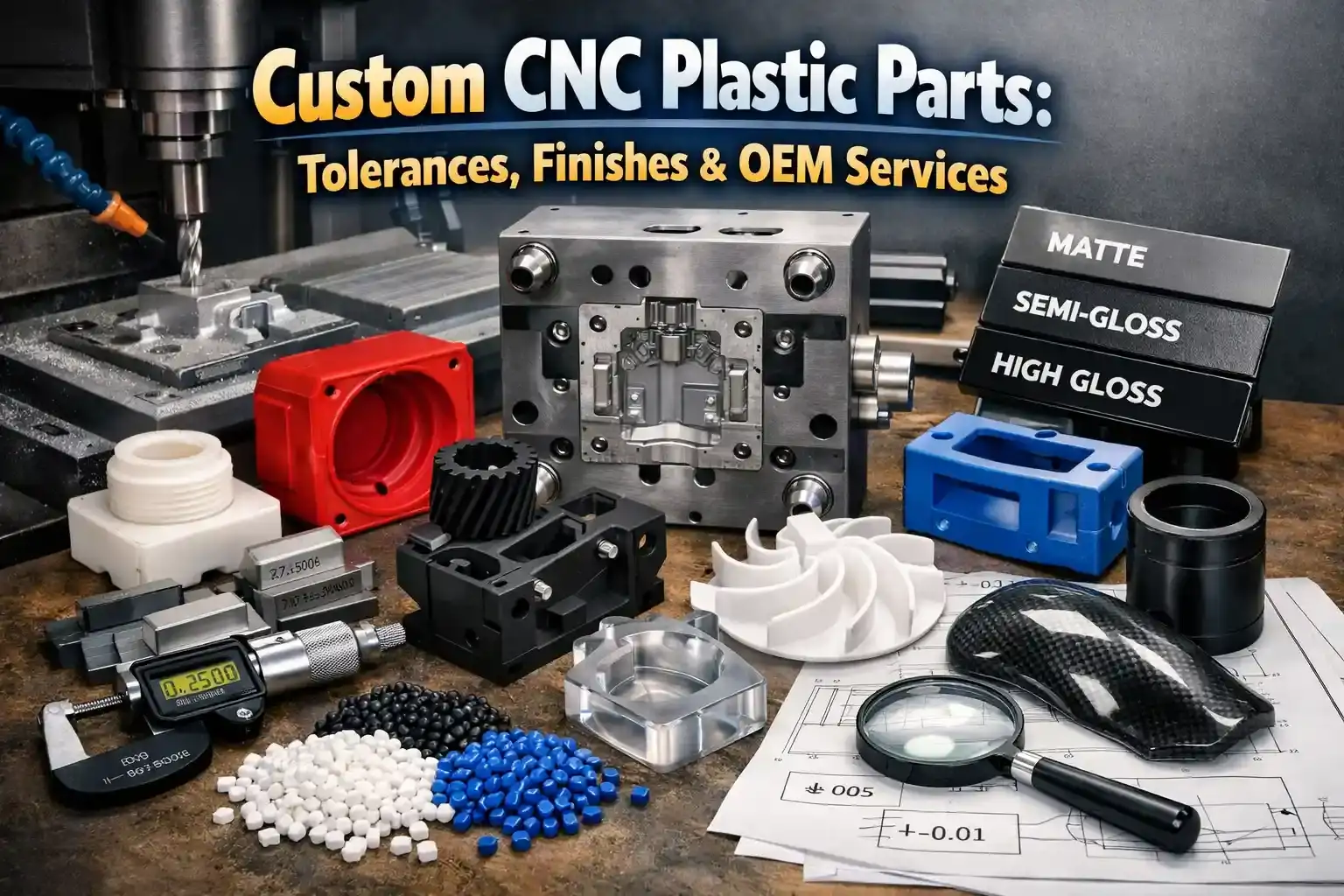
Producing accurate plastic parts demands more than just a quality machine. It requires the right materials and suppliers who know exactly what you need. Custom CNC plastic machining provides everything. It provides engineers, product developers, and OEM buyers with a tool for manufacturing extremely precise plastic parts based on their specifications. In this article, we will discuss tolerances, surface finishes, and OEM services for custom CNC plastic machining.
CNC plastic machining is the process of using a computer-controlled cutting tool to shape a block of plastic into a valuable product. A digital design file controls the machine. It is used to cut, drill, mill, and turn material to the exact part to fit the design.
The custom part is the one designed for you. No molds or tools are required. You give the drawing or CAD to the machine shop, and the machines are set up to create it. This is perfect for creating special parts, short production runs, and precision-toleranced parts.
Many industries include custom CNC plastic parts. Precision-machined plastic parts are used in medical devices, aerospace parts, electronics casings, automotive prototypes, and industrial equipment.
Beyond the machining process itself, materials can be an important factor. The properties and characteristics of plastics vary from plastic to plastic, and their machinability varies as well.
Engineering Plastics
PEEK, nylon, acetal, and polycarbonate are typical engineering plastics used in CNC machining. They have good mechanical, chemical, and dimensional properties. PEEK is especially suited for high-temperature applications and medical applications, owing to its outstanding properties.
General Purpose Plastics
Common materials for less critical applications include acrylic, ABS, and HDPE. They are easily cut and inexpensive. Acrylic is popular for optical and display uses because of its transparency.
High-Performance Plastics
For extreme chemical resistance or very low friction, PTFE or PPS can be used. They are more difficult to process, but superior in performance to conventional plastics. A reputable plastic CNC machine supplier should be able to guide you to the right material, based on the functional requirements and budget in your project.
Tolerance is the allowable variation in a part's dimensions. With tighter tolerances, the part will need to be closer to the specified actual dimension. It is important in situations that require tight tolerances or in applications where parts must meet stringent requirements.
Usually, the tolerances of the CNC plastic machining are 0.05mm to 0.1mm. For higher precision applications, tolerances down to ± 0.01mm are possible depending on the part geometry and material.
Factors That Affect Tolerance
The material is an important factor. Certain plastics absorb moisture and expand a little after a while. There are others with higher thermal expansions. Properties in these affect the stability of the part dimensions after machining. PEEK and acetal also have good dimensional stability. Nylon absorbs more moisture and changes in size more than other materials.
Another tolerance factor is part geometry. Simple flat features will be easier to maintain a tight fit than deep internal bore or thin walls. When setting up a job, a skilled machinist must consider these factors.
Why Tolerance Specification Matters
Choosing the correct tolerances for all features is crucial. Close tolerances are expensive because they require lower cutting speeds, better setup, and increased inspection. Only tighter tolerances than your application requires will be an extra expense. Talk with your supplier about which features are essential and which have more flexibility.
Surface finish creates the appearance, feel, and function of a part. Depending on your needs, you can receive your CNC plastic parts prepared in various surface conditions.
As-Machined Finish
This is the standard finish off the machine. It demonstrates the markings of tools used in cutting. It is usually between Ra 1.6 and 3.2 micrometers in surface roughness. In instances where appearance is not of paramount importance, an as-machined finish is satisfactory and the most economical choice.
Sanded or Smoothed Finish
Hand sanding is used to remove tool marks and smooth the surface. This is used when a cleaner appearance is required or when it is to be painted or bonded onto another surface. The different grinds give different smoothness.
Polished Finish
Polishing produces a smooth, shiny surface. It can be used commonly in acrylic and polycarbonate components for high clarity or high-value components. Polishing takes longer and costs more, but will enhance the appearance of the finished component.
Painted or Coated Finish
Some CNC-manufactured plastic parts are painted for aesthetic purposes or for protection. Surface preparation is necessary to ensure good adhesion of primer and paint to plastic. Improper adhesion of paint to some plastics will likely require chemical etching or flame treatment.
Anodizing and Plating
Some plastic parts are surface-metalized or receive a conductive coating for EMI shielding or decoration, which is more frequently used on metal parts. These are specialist processes used following machining.
OEM is the Original Equipment Manufacturer. In CNC plastic machining, OEM refers to the manufacturer that makes plastic parts according to your design and requirements, which you then sell or use under your brand. The manufacturer does not name the product. You do.
A full OEM service covers more than just machining the part. It has seen your design for manufacturability, recommended material and tolerance changes, manufactured parts to your quality requirements, applied the finish as required, and packed parts to your required specification. For regulated industries, some OEM suppliers may also provide quality documentation files, inspection reports, and traceability records.
One reason businesses use OEM CNC machining services is that it is cheaper than maintaining their own machining facility. You have access to professional equipment and skills, but you don't invest in them. You also benefit from the knowledge and experience the supplier has gained across a variety of projects and industries.
• Assess the supplier's technical expertise. Inquire about the machines they use, the materials that they use consistently, and the most precise tolerances that they can consistently produce. Ask to sample previous work to determine quality.
• Review their quality assurance devotion. Discuss their inspection equipment, such as CMMs and surface roughness machines.
• Communication matters too. A competent OEM Supply provides prompt and accurate technical answers. They examine your artwork thoroughly, marking any problems early in production so that they need not be discovered later. That is a proactive solution that helps avoid unnecessary errors and time loss.
Yes, this is one of its great benefits. There are no tooling expenses in CNC machining. You are charged for the usage of machines and materials. This makes it very cheap for quantities between one part and several hundred parts, with no minimum order requirement, which results in costly mold investment.
CNC plastic machining is a practical and cost-effective solution for startups, product developers, and businesses that require custom parts in small quantities. It is also easy to change your design at no extra cost, making it ideal for product development.
Custom CNC plastic machining ensures that the buyer will get exact control over their dimensions, materials, and surface finish. When the right supplier provides full OEM services, you can create top-tier plastic parts that meet your exact specifications. When selecting a supplier, keep in mind tolerance requirements, finish needs, and the supplier's competence. These three points will help your custom parts perform as you intended.
1- What is the source for retail buying of Custom CNC Plastic Parts?
Purchase certified CNC parts from manufacturers in Taiwan or China via a web portal such as Alibaba or Global Sources. When ordering in bulk, always sample and check tolerance for various materials.
2- How to Purchase Custom CNC Plastic Parts In Wholesale At Low Prices?
Talk to manufacturers directly. This way, you will skip resellers and get factory-level pricing.
3- Is there a custom CNC plastic parts supplier that customizes as well?
All CNC manufacturing companies in China or Taiwan provide OEM services, such as custom geometries and materials, custom finishes, and private labeling. Sources such as Alibaba and manufacturing trade shows can be trusted to provide verified suppliers.
4- Are there any custom CNC plastic parts suppliers who can provide a bulk supply and customization at a low price?
Yes, there are indeed many Chinese and Taiwanese manufacturers who provide factory-direct bulk quotes and do full OEM customizations at competitive prices.
If you source precision
READ FULLIf you’ve ever opened a quote for a titanium part and felt shocked to see the excessive pri
READ FULLEvery day, procurement teams across various industries like aerospace, medical devices, and indus
READ FULL

Have a question or need a quote? Fill out this form and our team will get back to you quickly!