



 +86 18368240367
 Jasonhardware@foxmail.com

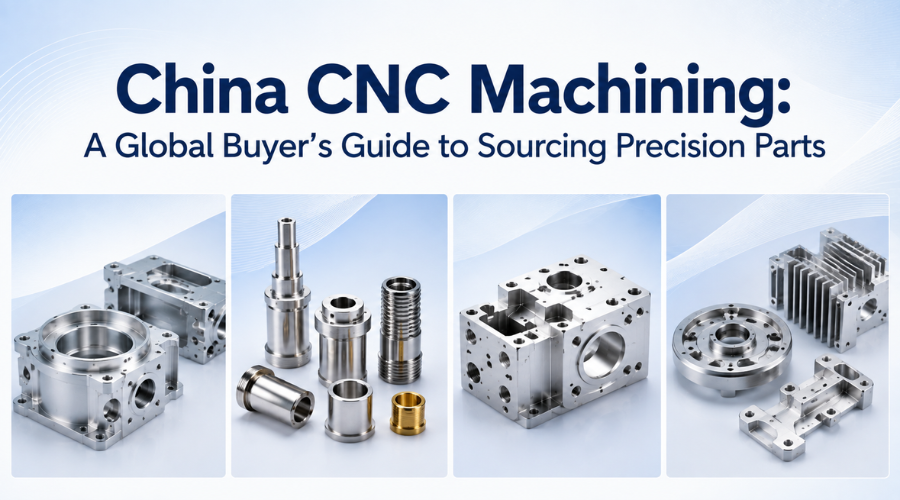
If you are sourcing precision components from China, the lowest quotation should never be your starting point. Your first question should be whether the CNC machined components manufacturer can consistently meet your drawings, tolerances, material specifications, quality requirements, and delivery schedule.
That carefulness during procurement matters because CNC machining parts sourcing is not simply a price comparison. You are selecting a manufacturing partner for long-term production that may become responsible for components affecting your product's performance and assembly.
For OEM manufacturers, procurement teams, and parts importers, the better approach is to move through a well-planned and structured sourcing process consisting of the following stepwise decisions: understand the supplier, classify its business model, evaluate capability, verify quality, assess manufacturing fit, compare processes, qualify performance, and only then move toward production.
The goal is simple. You want a supplier whose capabilities match your requirements and whose quality and production controls reduce your procurement risk.
Before comparing prices from Chinese machining suppliers, establish who is actually manufacturing your parts.
Start by determining whether you are dealing with a direct CNC machined components manufacturer, trading company, sourcing intermediary, integrated manufacturer, or specialized precision machining shop.
Ask practical questions:
Which machining processes are performed in-house?
Which processes are subcontracted?
Where are engineering, machining, inspection, and finishing performed?
Does the supplier regularly serve overseas OEM customers?
Can it handle both prototypes and recurring production?
What types of parts does it manufacture most frequently?
This step helps you separate claimed capability from demonstrated capability.
A supplier may list milling, turning, grinding, EDM, surface treatment, and other services on its website. That does not necessarily mean it owns all the manufacturing equipment or controls every process directly. For you as a parts buyer, the important issue is transparency. If a critical process in parts manufacturing is subcontracted or outsourced, you need to know who controls it, who inspects it, and who is responsible when something goes wrong.
Vital Question To Ask: Can the supplier clearly explain what it manufactures itself, what it outsources, and how final quality is controlled?
If the answer is vague, do not move directly to a production order.
Once you understand the supplier's operating model, determine whether it fits your sourcing requirements.
Direct CNC Machined Components manufacturer
A direct manufacturer owns or operates its machining equipment and manages production internally. This model can provide greater visibility into machining, inspection, scheduling, and quality control.
For recurring OEM production, direct manufacturing can also simplify technical communication because your drawings and process requirements reach the production team more directly.
Trading company or sourcing intermediary
An intermediary coordinates manufacturing through external factories. This can provide access to a wider range of processes, but you need to examine traceability, technical communication, and quality ownership more carefully.
You should know exactly which factory will produce your components before approving production.
Integrated manufacturing supplier
Some suppliers combine CNC machining with finishing, heat treatment, inspection, assembly, or other secondary operations. This can reduce the number of vendors you need to coordinate, particularly when your components require several downstream processes.
Specialized precision shop
A specialist may focus on capabilities such as 5-axis machining, Swiss turning, EDM, or grinding. If your parts have complex geometries or tight tolerance requirements, then a specialized manufacturer with selected tolling capabilities may be more valuable than a broad service portfolio.
The right supplier type depends on your parts, volumes, tolerances, and supply-chain requirements. Do not assume that the largest supplier is automatically the best fit.
The key question is not, “What machines does this supplier have?”
It is, “Can this supplier repeatedly make my parts to specification?”
Start with the equipment. Review the supplier's CNC milling and turning capabilities, machine configurations, working envelopes, axis capabilities, tooling, fixtures, and relevant secondary processes.
If your components require complex multi-face machining, confirm whether the supplier has suitable 4-axis or 5-axis equipment. If your demand is for small, precise turned components, then Swiss machining is a better fit so look for that offering. For hardened materials or custom features, verify if EDM or grinding capability is available or not.
Then evaluate engineering capability
A capable parts supplier should be able to review your 2D drawings and 3D CAD files, identify potential manufacturability issues, question unrealistic requirements, and suggest practical solutions. This is particularly important when you are moving from prototype quantities to repeat production.
Capacity is another aspect that you should consider
Ask how many relevant machines are available, how heavily they are currently committed, and whether the supplier can scale up the output to match increases in your monthly volume. A supplier that can produce your first 500 parts may not necessarily be equipped to support your next 10,000.
Capability is more than equipment availability. It demonstrates production competence.
Quality qualification should go beyond asking whether a supplier is “ISO certified.”
You should start by examining the entire quality management system of the parts manufacturer. Look for documented quality protocols relating to incoming material inspection, in-process inspection, final inspection, calibration, nonconformance handling, and corrective action.
Then examine actual inspection capability
Depending on your requirements, you may need access to:
CMM inspection
Optical measurement systems
Micrometers and precision gauges
Height gauges
Surface roughness measurement
Hardness testing
Material verification
Do not stop at photographs of inspection equipment. Ask for sample inspection reports and determine whether the supplier can measure the critical dimensions on your drawings.
Material quality control is equally important for OEM components procurement. So your quality assessment phase should also check for how the supplier verifies material grades, maintains mill or material certificates, controls batch traceability, and handles material substitutions.
For components requiring heat treatment or surface finishing, determine how those processes are documented and verified.
The critical question is simple:
Can the supplier prove that the component met your specification, or does it simply tell you that it did?
Even a highly capable supplier may be the wrong supplier for your specific components. And that is why you must assess a supplier’s manufacturing fit across five areas: geometry, tolerance, material, volume, and secondary operations.
The way to do this manufacturing fit assessment is to first consider your parts' shape and dimensions, whether they are prismatic, cylindrical, complex 3D, thin-walled, or feature-heavy. After that, examine the tolerances that actually matter for function and assembly.
Do not automatically specify the tightest possible tolerance. Tighter tolerances can increase machining time, tooling demands, and overall cost. Your supplier should be able to distinguish between critical dimensions and tolerances that do not impact part performance.
Material quality is another important consideration. Aluminum, stainless steel, carbon steel, titanium, and engineering plastics each present different machining and finishing requirements.
Finally, match the supplier to your production volume.
A prototype-focused shop may be excellent for development work but less suitable for recurring high-volume production. On the other hand, a high-capacity production facility may not be the most economical option for a small engineering run.
Your best supplier is the one whose strongest manufacturing capabilities fulfill your most important part requirements.
Process selection should be treated as a manufacturing decision, not simply as the supplier's preference.
CNC milling is generally suitable for brackets, housings, plates, pockets, slots, and other prismatic components.
CNC turning is appropriate for shafts, pins, bushings, fittings, and other rotationally symmetric parts.
For components combining turning and milling features, mill-turn machining can reduce setups and improve process efficiency when the geometry supports it.
5-axis CNC machining becomes useful in parts having complex geometries. These parts have complex surfaces, multiple faces, or difficult access requirements. Making them requires repeated fixturing, which is impractical.
For small, long, or slender precision components, Swiss machining may offer a better manufacturing route, particularly for recurring production.
Other processes such as EDM and grinding may be appropriate where conventional cutting cannot provide the required feature, hardness capability, surface condition, or dimensional precision.
When comparing processes, work through this sequence:
Geometry → tolerance → material → volume → setup requirements → inspection requirements → total cost.
Do not allow a custom CNC machined parts supplier to force every component into the process it happens to have available. The manufacturing process should fit the part.
Once you have narrowed your list of prospective suppliers, use a scorecard that assesses qualification areas on a weightage basis and rank your vetted suppliers according to that scorecard.
The weighting can change according to your product and risk profile. For a safety-critical OEM component, for example, quality and technical capability may deserve substantially more weight than price.
To assess each aspect you will need to get access to the following information and documentation:
Equipment and capability information
Relevant quality certifications
Inspection equipment details
Sample inspection reports
Material certificates
Examples of comparable components
Production capacity information
Quality-control procedures and protocols
Expected lead times
Prototype or sample-production capability
If a manufacturer fails or hesitates to provide this information, it is a clear red flag.
After a supplier has passed your initial qualification and scorecard assessment, the work is still not finished, and you must evaluate whether they can deliver what they claim through a sample order. For this you must follow the same rational approach involving multiple stages.
This stage involves confirming drawings, CAD files, materials, tolerances, surface finishes, quantities, packaging, and inspection requirements.
Place a sample order and use the first batch to evaluate dimensions, material, finish, parts functionality, and service efficiency of the manufacturer/supplier.
Establish acceptance criteria before you start volume production.
This is the second-to-last stage where you lock in the approved drawings, revision levels, inspection requirements, packaging standards, and change-control procedures.
Track on-time delivery, defects, rework, corrective actions, documentation accuracy, responsiveness, and cost changes.
This staged approach gives you an opportunity to identify problems when they are still manageable.
Before approving a custom CNC machined parts supplier, ask seven questions:
Can the supplier manufacture my specific geometry and materials?
Can it consistently achieve my critical tolerances?
Can it demonstrate an appropriate quality and inspection system?
Does its production capacity match my expected volume?
Does its manufacturing process fit the part rather than simply its available equipment?
Can it provide the documentation and traceability that fits my supply chain procurement operation?
Has it demonstrated performance through samples or controlled production?
Approve when the evidence is strong across main aspects like capability, quality, manufacturing fit, delivery, communication, and commercial terms.
Proceed cautiously when the custom CNC machined parts supplier fulfills documentation but has not yet demonstrated production quality practically or when important processes are outsourced without sufficient visibility.
Reject when the supplier cannot provide credible evidence of capability, quality control, or accountability.
The strongest sourcing decision is rarely the supplier offering the lowest unit price. It is the supplier whose technical capability, quality system, manufacturing process, capacity, and commercial terms align with your actual production requirements.
That is how you move from simply buying CNC parts to building a reliable precision-component supply chain based on a long-term partnership with the supplier. And for OEM manufacturers and procurement teams operating in the competitive industrial sectors where success depends on delivering quality at a low cost, a reliable parts supply chain can become a genuine sourcing advantage.
Among amateur metal machinists and engineers, ther
READ FULLElectrical applications demand high conductivity, and compromising o
READ FULL

Have a question or need a quote? Fill out this form and our team will get back to you quickly!