



 +86 18368240367
 Jasonhardware@foxmail.com

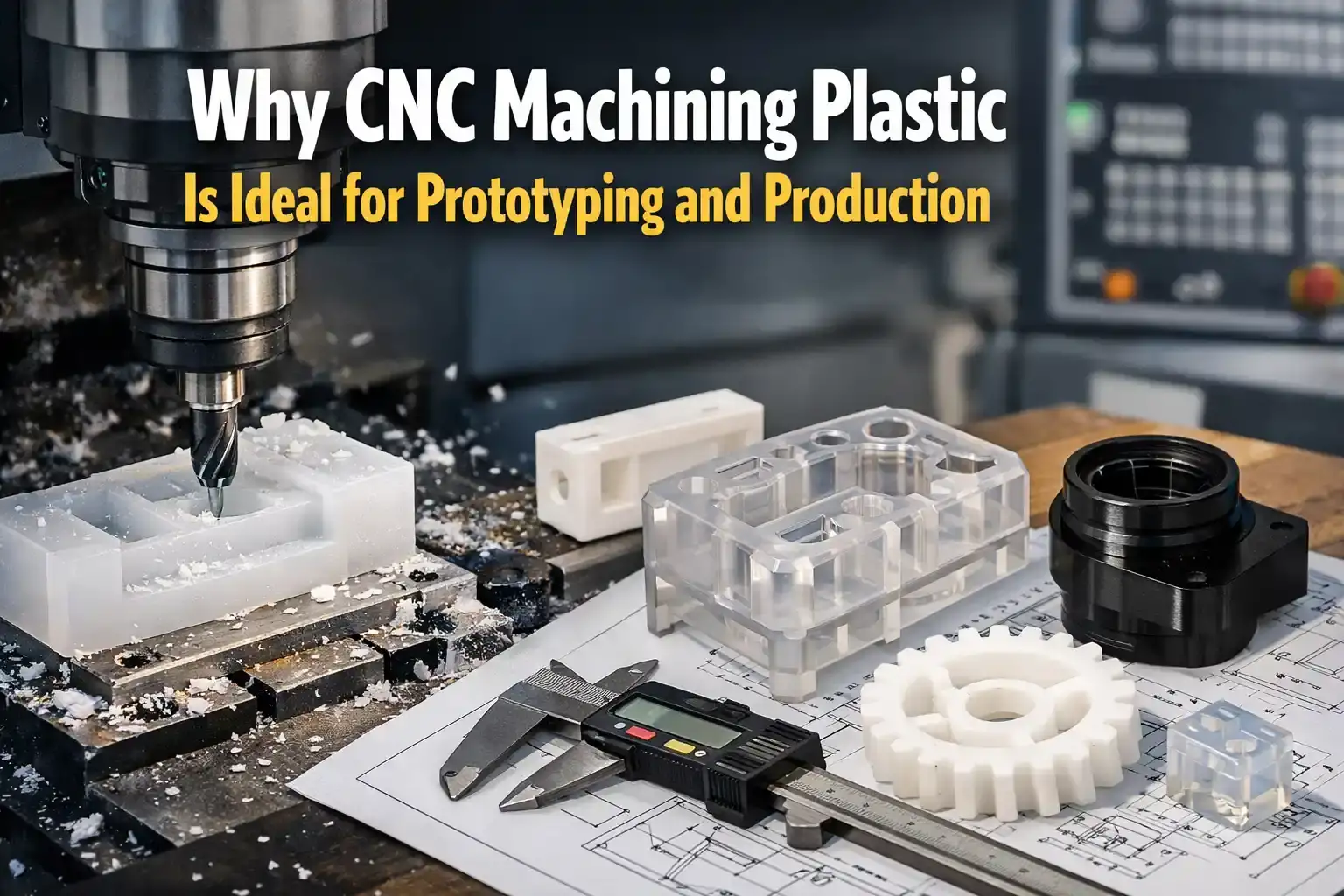
The shift toward engineering plastics in critical applications is accelerating. Aerospace manufacturers are replacing aluminum brackets with advanced polymers to save weight. Automotive suppliers are specifying plastic components for EV battery systems where electrical insulation is non-negotiable. Medical device companies require materials that survive repeated sterilization without corroding.
This trend creates a procurement challenge. Traditional injection molding demands expensive tooling and long lead times. It only makes sense when volumes justify the upfront investment. Keeping in mind these limitations, the central issue to achieve profitability is ‘How to produce precision plastic parts for prototyping and low-to-medium volume production without investing in a mold that costs USD 50,000 and takes weeks to build.
The answer is CNC machining plastic. It delivers production-intent precision from day one. It eliminates tooling risk entirely. And it gives you access to the full spectrum of high-performance polymers: PEEK, Ultem, PTFE, POM without requiring minimum order quantities that strain your budget.
For bulk buyers in aerospace, automotive, and medical sectors, this is not a niche capability. It is a strategic manufacturing option that deserves serious evaluation. And in this blog, we are going to do exactly that.
No Tooling Investment
Let us start with the most obvious advantage. Injection mold tooling for a typical plastic part ranges from USD 10,000 to over 100,000 dollars. The lead time stretches from six to twelve weeks. If your design changes and designs always change that tooling becomes scrap.
CNC machining plastic requires none of that. The upfront investment is programming and setup, measured in hours, not weeks. First articles can ship within days of finalizing the CAD model. For bulk buyers evaluating new product designs or uncertain production volumes, this eliminates the risk of sinking capital into tooling that might never reach its payoff volume.
Consider a medical device company developing a new surgical instrument handle. They need functional prototypes for surgeon trials. They also need three hundred units for initial clinical evaluation. And if the design changes after feedback, they need to iterate quickly. Injection molding cannot serve that scenario economically. CNC machining can.
Rapid Design Iteration Speed
Engineering validation testing demands rapid iteration. In every advanced manufacturing sector testing protocols are crucial for quality. Aerospace components undergo structural testing. Automotive parts require fit checks against existing assemblies. Medical devices need usability evaluations with clinicians. Each round of testing reveals something that should change.
With CNC machining plastic, a design revision means editing the CAM program and running a new part. The cost is only a few hundred dollars. The turnaround is days. With injection molding, that same revision means modifying the mold or building a new one which costs thousands of dollars. The lead time is weeks.
The gap widens with every design cycle. Industry data shows that product development programs average four to six major design revisions before finalization. Each revision that avoids mold modification saves both time and capital. For bulk buyers managing multiple SKUs across different product lines, those savings compound rapidly.
Material Versatility
Here is where many procurement professionals underestimate the value of CNC machining. Engineering plastics are not commodity materials. PEEK offers high-temperature resistance up to two hundred sixty degrees Celsius. Ultem provides inherent flame retardancy with UL 94 V-0 rating. PTFE delivers near-universal chemical resistance. POM, or Delrin, offers low friction and excellent dimensional stability.
These materials are available in sheet, rod, and tube forms. A CNC machinist can program a part in PEEK on Monday, switch to Ultem on Tuesday, and run PTFE on Wednesday. No tooling change. No minimum order quantity. No material-specific mold investment.
But you need to select an experienced shop that has expertise in a specific material machining. Machining PEEK requires specific spindle speeds, feed rates, and tool geometries. Inexperienced shops improperly handle the material generating too much frictional heat which melts the polymer. This means that the tolerance is ruined and surface finish is crude. An experienced machining firm may ask more from your pocket but the flexibility and design freedom they will offer will be well worth it.
Precision at Prototype Stage
A prototype that does not match the production goals means a waste of time. Injection-molded prototypes usually have faults like shrinkage, flow lines, and weld lines that differ from the final part. Those differences gives rise to assembly issues or structural performance that is not up to the mark.
Those kinds of faults are not present in CNC-machined plastic parts. They are cut from solid stock. The material structure remains homogeneous. There are no flow lines because the process involves no flow. Weld lines are absent because there is no weld point. The dimensional accuracy exactly matches what you would expect from production tooling.
Weight Reduction
The simplest argument for plastic is weight. Engineering polymers like PEEK and carbon-fiber-reinforced composites have much lighter than aluminum and this makes them well-suited for moderate load applications. The weight savings can be sizable, about 40 to 60% compared to equivalent metal components. This is particularly important for aerospace and automotive industries.
Corrosion Resistance
Metal corrodes. Aluminum oxidizes. Steel rusts. Stainless steel can pit in chloride environments. These failures require coatings, platings, or material upgrades that add cost.
Plastics do not corrode. Period. Medical equipment undergoes repeated sterilization with aggressive chemical agents. Automotive underhood components face road salt, coolant, and humidity. Aerospace components encounter hydraulic fluids and deicing chemicals. In all these environments, plastic CNC parts maintain their integrity without secondary protection.
This is not a minor advantage. Eliminating plating or anodizing removes a processing step, a supplier relationship, and a potential failure mode from your supply chain.
Electrical and Thermal Insulation
Plastics are naturally insulating. They do not require secondary dip coatings or anodizing to prevent current leakage. In electric vehicle battery packs, plastic CNC parts isolate high-voltage connections and prevent arcing between terminals. In medical devices, insulation eliminates leakage current paths that could harm patients.
The regulatory implications are significant. FDA submissions for Class II medical devices require demonstrated electrical safety. Using inherently insulating materials simplifies that compliance path. No additional testing for coating integrity. No risk of coating failure over the device lifetime.
Chemical Resistance
Different applications demand different chemical resistance profiles. PTFE withstands virtually all industrial chemicals. PEEK resists hydrocarbons, acids, and bases at elevated temperatures. POM performs well in fuel and solvent environments.
Metal components require careful material selection for chemical exposure. Plastics offer a simpler solution. Choose the right polymer, and the chemical resistance is guaranteed without any need of additional coatings or maintenance.
For semiconductor equipment manufacturers and chemical processing buyers, this is the deciding factor. Nothing else matters if the material cannot survive the operating environment.
Cost at Low Volumes
Here is the economic reality. CNC machining a plastic bracket at quantities under five hundred units typically costs thirty to fifty percent less than machining the same geometry in aluminum. The reasons are straightforward. Plastics cut faster, reducing cycle time. Standard grade materials like POM and Nylon cost less per pound than aluminum. Tool wear is lower, extending tool life.
The cost gap narrows at high volumes. Injection molding wins at scale. But for prototyping and mid-volume production — defined as one to one thousand parts — plastic CNC machining is the clear economic winner.
Bulk buyers should run the comparison for their specific parts. The data consistently favors plastic at lower volumes.
The trend of utilizing plastics in the industrial sector will only grow with time. Lightweighting, corrosion resistance, electrical insulation, and regulatory compatibility of plastics make this material a top choice across aerospace, automotive, and medical sectors. For bulk buyers in these industries, CNC machining plastic offers the fastest path from design to functional part with production-intent precision and no tooling commitment.
The advantages of plastic over metal are real and measurable. Weight savings of forty to sixty percent. Inherent corrosion resistance. Natural electrical insulation. Chemical compatibility. Lower cost at prototype and mid-production volumes. Regulatory compliance is built into the material itself.
CNC machining plastic is not the right answer for every part. High-volume, simple-geometry parts in commodity materials belong in injection molds. But for prototyping, mid-volume production, tight tolerances, high-performance materials, and complex geometries, CNC machining is often the superior choice.
The variable that determines success is the supplier. Choose one with the process expertise, quality certifications, and material knowledge that your industry demands. The technology is mature and reliable. The decision is yours.
Among amateur metal machinists and engineers, ther
READ FULLElectrical applications demand high conductivity, and compromising o
READ FULL

Have a question or need a quote? Fill out this form and our team will get back to you quickly!