



 +86 18368240367
 Jasonhardware@foxmail.com

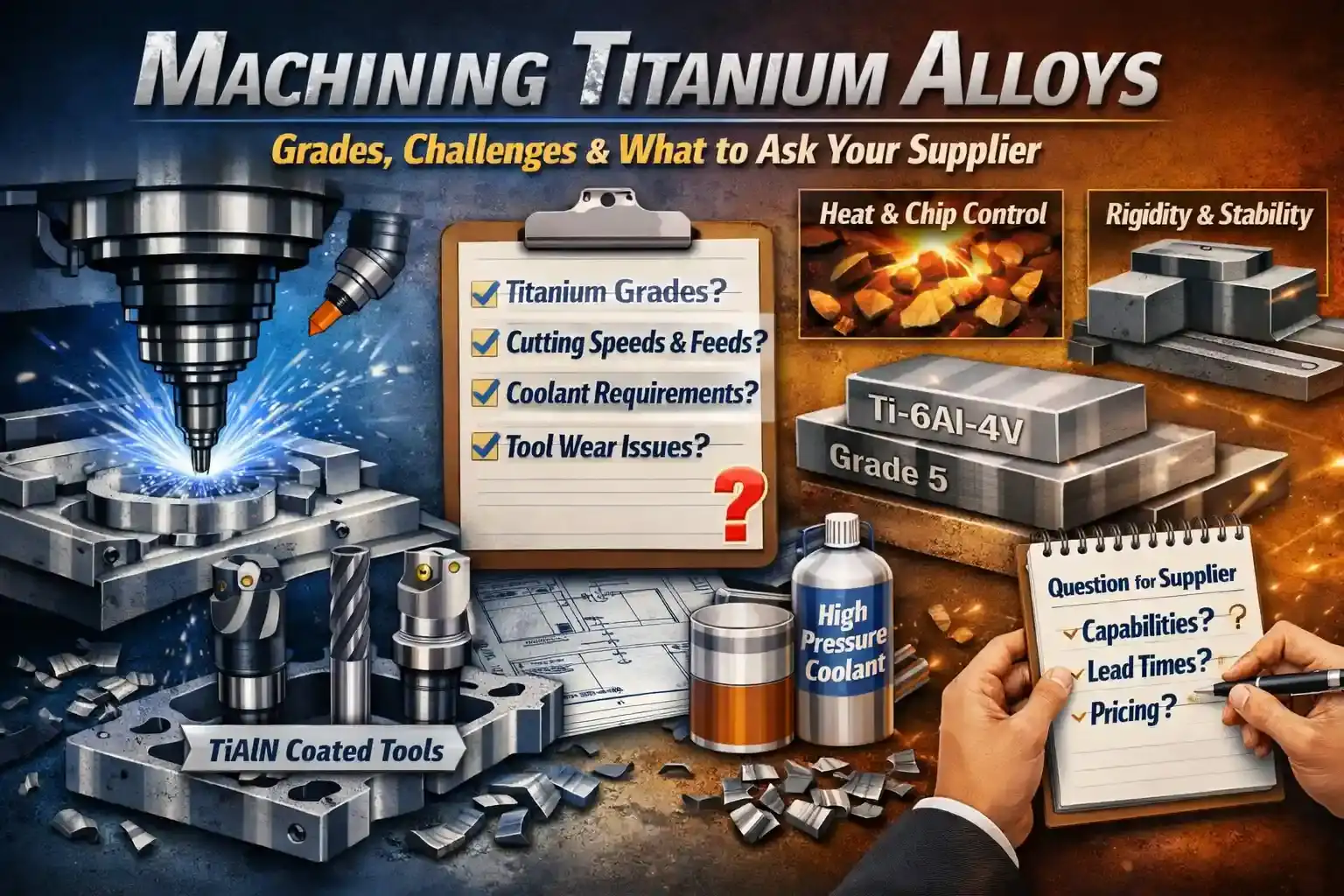
If you’ve ever opened a quote for a titanium part and felt shocked to see the excessive price, then that is a pretty common occurrence in the industry. For procurement professionals in aerospace and medical equipment manufacturing, titanium is a double-edged sword. On one side, it offers an unbelievable combination of strength, weight savings, and corrosion resistance. But the operational drawbacks like machining difficulty, can torpedo budgets and extend lead times.
The challenge is real. Titanium’s low thermal conductivity means heat stays concentrated at the cutting edge rather than dissipating through the workpiece. That contributes to tool degradation and tool life is severely reduced. The same does not happen with aluminum. But with the right knowledge, you can eliminate these issues. This blog cuts through the complexity, helpingproperty that can reduce tool life to a fraction of what you’ you select the right grade, understand what makes titanium difficult to machine, and ask the questions that separate qualified suppliers from the rest.
Choosing a titanium alloy isn’t just about strength. It’s about balancing performance requirements against manufacturability and cost. The decision you make here has an impact on every subsequent stage of production.
Grade 2: The Variant for Non-Structural Applications
Commercially pure Grade 2 titanium offers excellent corrosion resistance and formability. With tensile strength around 345 MPa, it’s not the strongest option, but its corrosion resistance offsets that lack of strength. For applications where corrosion resistance matters more than load-bearing capacity, Grade 2 is often the better choice.
Here’s why procurement professionals appreciate it: Grade 2 machines significantly faster than its alloyed counterparts, with markedly less tool wear . If your part doesn’t need to carry structural loads, specifying Grade 2 can reduce machining costs by 30–50% compared to Grade 5 . Consider it for ducting, brackets, covers, marine components, and chemical processing equipment .
Grade 5 (Ti-6Al-4V): The General Industry Standard
Grade 5 accounts for roughly half of global titanium usage and there is a solid reason for it. With tensile strength around 950 MPa and excellent fatigue resistance, it’s the go-to alloy for aerospace structures, engine components, and high-performance automotive parts .
The trade-off? It’s considerably more difficult to machine. Expect slower cutting speeds, higher tool wear, and mandatory high-pressure coolant systems . If your application truly requires the strength-to-weight ratio Grade 5 provides, the machining cost is justified—but don’t specify it unless your stress analysis demands it .
Grade 23 (Ti-6Al-4V ELI): When Fracture Toughness Matters
Grade 23 is essentially Grade 5 with reduced oxygen and iron content. This distinction matters for two specific scenarios. One is for fracture-critical components where damage tolerance is crucial. Second is for applications where the exposure to extremely low temperatures can make Grade 5 brittle.
Grade 23 is mostly used in surgical implants (ASTM F136) and critical aerospace components. Machining costs are similar to Grade 5, but lead times for large-format billets can be longer, so plan accordingly .
Other Grades Worth Knowing
• Grade 9 (Ti-3Al-2.5V): A middle-ground option stronger than Grade 2 but more formable than Grade 5. Common in hydraulic tubing and bicycle frames .
• Beta alloys (e.g., Grade 19): Offer the highest strength through heat treatment, used for springs and fasteners .
To evaluate suppliers effectively, you need to understand what makes titanium different from other materials. It’s not just about being “hard” to machine—it’s about specific physical properties that demand specialised approaches.
The Heat Problem
Titanium’s thermal conductivity is roughly 7 W/m·K, compared to 205 W/m·K for aluminum. During cutting, up to 80% of the heat generated stays concentrated at the tool edge rather than dissipating throughout the surface of the workpiece. That constant exposure to frictional heat means the cutting tool wears out faster, and this also affects surface smoothness.
Chemical Reactivity
At elevated temperatures, titanium becomes chemically reactive and can weld itself to the cutting tool which is a phenomenon called galling or built-up edge. This alters the tool geometry, increases cutting forces, and leaves poor surface finishes.
Work Hardening
Titanium work-hardens rapidly. If a tool rubs against the material rather than taking a clean cut, it creates a hardened surface layer that makes subsequent passes even more difficult . This is why hesitant machining is particularly destructive with titanium.
Tool Life Reduction
A carbide end mill that lasts hours in aluminum may survive only 20–30 minutes in Grade 5 titanium . Tooling consumables alone can add $5–$15 per part on typical aerospace components . This is why supplier expertise matters, as experienced shops know how to optimise parameters to extend tool life and control costs.
For procurement professionals looking to source top-grade titanium parts finding suppliers that truly have the expertise to handle titanium machining becomes a difficult task. To resolve this you need some important qualifying questions for evaluating suppliers. Here are the questions that separate the qualified from the questionable.
Have They Done similar projects before?
Ask: “What specific titanium alloys have you machined, and for which applications?”
Look for: Detailed case studies, not generic claims. A supplier should be able to reference similar geometries and tolerances they’ve achieved .
Ask: “What were the biggest challenges you faced on titanium projects, and how did you solve them?”
Red flag: Vague answers or reluctance to share technical details.
Do They Understand the Material?
Ask: “What cutting parameters and tool coatings do you use for Grade 5?”
Look for: Specific references to speeds, feeds, and coatings like TiAlN or AlTiN . They should understand that high-pressure coolant (1,000+ PSI) is mandatory for Grade 5 .
Ask: “How do you manage heat generation and work hardening?”
Look for: Knowledge of climb milling, proper chip load, and stress-relief strategies .
Are They Industry-Recognised?
Ask: “What certifications do you hold?”
Look for: ISO 9001, AS9100 (aerospace), or compliance with ASTM standards . Third-party validation carries more weight than self-proclaimed expertise.
Ask: “Who are your current clients in our industry?”
Look for: Partnerships with known OEMs or listings in industry directories .
Can You Rely on Them?
Ask: “What is your typical lead time and on-time shipping rate?”
Look for: Specific metrics, not general assurances. On-time delivery is a core competency, not a nice-to-have .
Ask: “What are your quality control procedures?”
Look for: 100% dimensional inspection, CMM verification, material certification, and traceability .
Supplier Capability Checklist
When evaluating potential partners, use this checklist to verify they have what it takes:
|
Capability |
Why It Matters |
|
Multi-axis CNC (3/4/5-axis) |
Essential for complex geometries |
|
Tolerance to ±0.005mm or better |
Critical for precision applications |
|
High-pressure coolant (1,000+ PSI) |
Necessary for heat management |
|
Specialised carbide tooling with coatings |
Extends tool life, improves surface quality |
|
Surface treatment options |
Anodizing, passivation, polishing |
|
Material certification and traceability |
Regulatory compliance |
|
CMM and surface quality inspection |
Dimensional accuracy verification |
|
Flexible MOQs (prototype to production) |
Supports R&D through full-scale manufacturing |
Renjiu Machinery: Manufacturing Excellence in Titanium
Ningbo Renjiu Machinery Co., Ltd. specializes in custom titanium alloy CNC machining for demanding applications. If you’re evaluating suppliers for aerospace or medical components, Renjiu offers the complete package.
• Manufacturer-direct pricing: No intermediary markups so the cost savings are passed directly to you.
• Fast turnarounds: Sample lead times of 7–15 days.
• On-time shipping: A proven track record verified through real customer orders.
• Flexible MOQs: From 1-piece prototyping to 50,000+ units per month—no minimum order restrictions for prototypes.
• Quality customer service: Dedicated engineering support, DFM analysis, and responsive communication throughout the procurement cycle.
Machining titanium alloys requires specialized knowledge backed up by an advanced setup, and rigorous quality control. For procurement professionals, selecting the right supplier isn’t just about getting the lowest quote. It is about verifying technical capability of the supplier through evidence-based evaluation. By applying a tried and tested verification procedure, you can identify partners who deliver consistent quality, on-time performance, and competitive pricing.
Titanium is a demanding material, but with the right partner, it can become easy to source parts that meet industry standards. Ask the right questions, verify the answers, and choose a supplier who understands that titanium isn’t just another metal but a strategic investment in your project’s success.
If you source precision
READ FULLIf you’ve ever opened a quote for a titanium part and felt shocked to see the excessive pri
READ FULLEvery day, procurement teams across various industries like aerospace, medical devices, and indus
READ FULL

Have a question or need a quote? Fill out this form and our team will get back to you quickly!