



 +86 18368240367
 Jasonhardware@foxmail.com

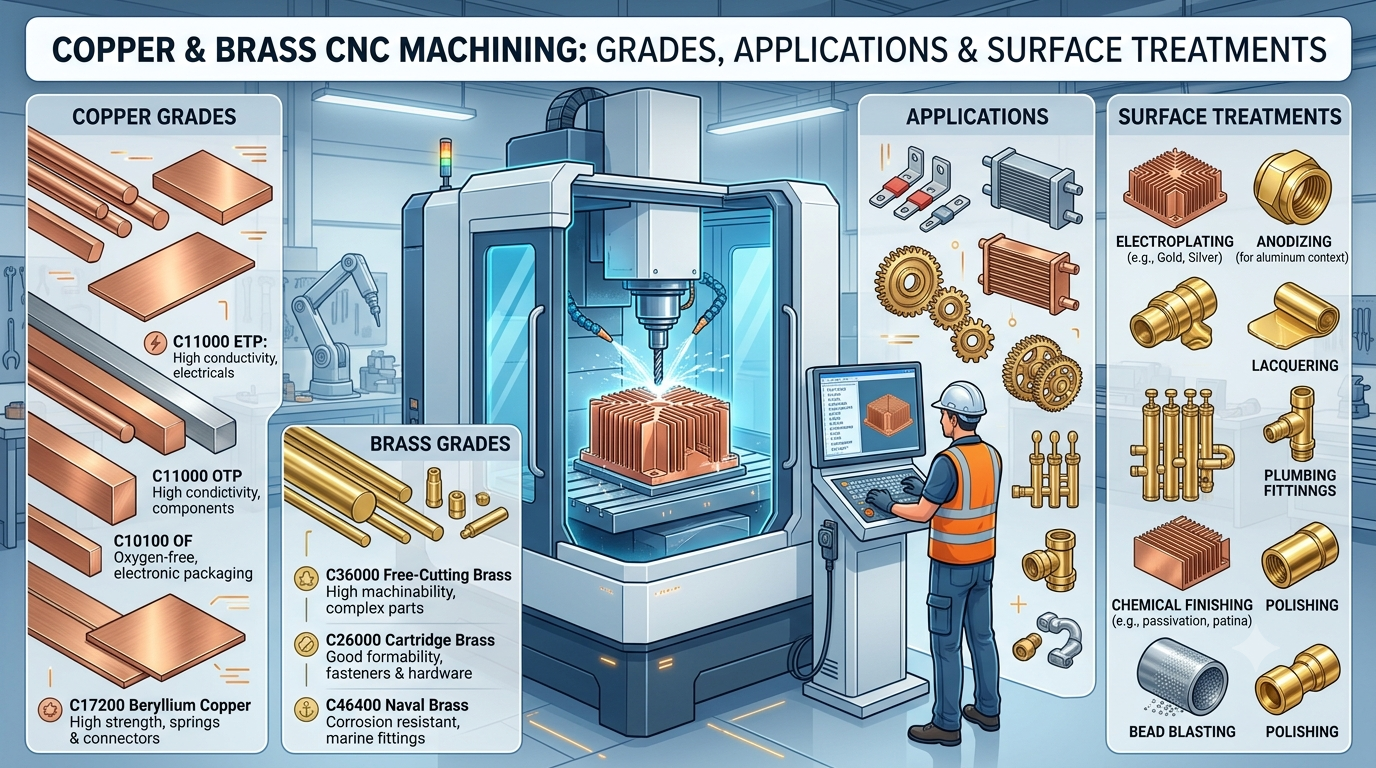
If you source precision metal components for electrical or electronic systems, you already know that copper and brass are non-negotiable materials. They deliver the conductivity, thermal dissipation, and EMI shielding that your products simply cannot function without. Yet specifying the right grade, machining approach, and surface finish often feels like navigating a maze of trade-offs, cost pressures, and supplier capability gaps.
This guide exists to cut through that complexity. Rather than overwhelming you with metallurgical theory, we will discuss the practical decisions that plague OEM buyers when they want the components that match product quality goals. We will take a deep dive into grade selection, design for manufacturability, finishing options, and supplier qualification. Because we know that the thing that will give you the competitive edge is cost-effective parts procurement without compromising field performance.
Before diving into specific grades for both metals we need to take a step back and understand the core difference between these two material families. Pure copper contains over 99 percent copper, which gives it exceptional electrical and thermal conductivity. The downside? It is relatively soft to machine. Chips do not break cleanly, tool wear accelerates, and burrs form readily.
Brass, by contrast, is a copper-zinc alloy. Adding zinc reduces conductivity but the benefit is easier machinability, strength, and better corrosion resistance. As an OEM electrical buyer, perhaps the most important trade-off that will always affect your choice is conductivity versus machinability versus environmental durability. Every application pushes one of these factors to the forefront, and your material choice must reflect that priority.
C101 – Oxygen-Free Electronic Copper
When your application demands the absolute highest conductivity such as high-frequency RF components, or low-loss power contacts, C101 is your answer. It delivers 100% conductivity with minimal impurities.
However, you should go into this choice with eyes wide open. Machining C101 is challenging and requires exceptionally sharp tooling along with aggressive chip-breaking strategies, and often optimized coolant delivery. The goal is to prevent built-up edge on cutting tools. Cycle times will be longer, and rejection rates will climb if your supplier lacks experience with this grade. Specify C101 only when the electrical performance truly justifies the manufacturing premium.
C110 – Electrolytic Tough Pitch Copper
For the vast majority of power distribution applications: terminal blocks, heat spreaders, grounding straps, C110 is the general-purpose material. It offers roughly 100 percent IACS conductivity at a lower cost than C101.
That said, you must be aware of one critical limitation. C110 contains oxygen, which makes it susceptible to hydrogen embrittlement if you plan to plate it. For critical plated components, you will need to specify a post-plating baking cycle to drive out trapped hydrogen. Otherwise, you risk parts that crack or fail prematurely in the field.
C145 – Tellurium Copper
If your design consists of deep holes, fine threads, or tight tolerances, C145 deserves serious consideration. With 85 to 90% conductivity and significantly easier machinability, this grade is the perfect fit in high-volume parts production.
The trade-offs are relatively minor compared to the performance. You sacrifice about 10% conductivity compared to C110, but you gain faster cycle times, longer tool life, and better surface finishes.
C182 – Chromium Copper
For components that welding electrodes, sliding switch contacts, or wear-prone interfaces—C182 offers moderate conductivity around 80%. Where it really delivers is in superior strength and wear resistance. This is not your everyday power conductor; it is a specialty grade for applications where durability matters as much as electrical performance.
C360 – Free-Cutting Brass
When machinability is your top priority, C360 sets the benchmark. It hits the mark in all aspects from excellent chip formation, to superior surface finishes. Tool wear is also not an issue even in complex geometries. At roughly 26% IACS conductivity, it suits low-current applications such as connector housings, fuse holders, threaded inserts etc.
For high-volume threaded parts, C360 is often the most cost-effective choice. The machining savings outweigh the slightly higher material cost compared to other brass grades.
C464 – Naval Brass
Outdoor utility cabinets, pole-mounted equipment, and electronic for marine environments require corrosion resistance beyond what standard brass provides. C464 is a brass alloy that has additions of tin to enhance salt-spray and humidity performance, making it the top option for harsh environments.
Be prepared, however, for slightly harder machining. C464 does not cut as freely as C360, so your supplier will need rigid fixturing and potentially reduced feeds and speeds. Factor this into your cost projections also.
C260 – Cartridge Brass
For stamped contacts that undergo secondary CNC operations—drilling, tapping, or milling—C260 offers high ductility and excellent cold-working characteristics. It is commonly specified for battery terminals and spring-loaded interconnects where formability matters.
Because C260 is often processed through both stamping and machining, you will want to work closely with your supplier on handoff points. Clear print notes about which features are stamped versus machined prevent confusion and ensure consistent quality.
Lead-Free Alternatives – C693 and C89510
Regulatory drivers—RoHS, California Prop 65, and customer sustainability mandates are pushing many buyers toward lead-free brass alternatives. These grades are improving, but you should expect 10 to 20 percent longer machining cycles compared to C360.
Get these regulatory requirements cleared up early if your product roadmap requires future compliance. Do not wait until a customer asks for lead-free certification; test them in your actual assembly environment and validate all electrical, mechanical, and environmental performance criteria before committing to a production transition.
Tolerances
Copper and brass can reliably hold tolerances of plus or minus 0.025 millimeters. That said, you should specify tight tolerances only on functional mating surfaces. Over-tolerancing non-critical dimensions inflates inspection time, and drives cost upward while having no impact on product performance.
Minimum Wall Thickness
To prevent distortion during machining, maintain minimum wall thicknesses of 0.5 millimeters for brass and 0.8 millimeters for copper. Pushing below these thresholds will result in out-of-tolerance parts.
Deep Holes and Chip Evacuation
For holes with depths exceeding four times the diameter, carbide tooling and peck-drilling cycles should be done. Copper's gummy chips can break tools, so proper chip evacuation strategies are non-negotiable.
Burr Control
Program climb milling and specify a secondary vibratory deburring step. Burrs on copper or brass components can cause intermittent electrical shorts in assembled products, leading to field failures that are expensive to diagnose and correct. Investment in deburring pays for itself many times over.
Surface Finish
Standard finishes of Ra 0.8 to 1.6 micrometers are achievable and sufficient for most electrical applications. If you go below 0.4 micrometers then it will only add cost and delivers minimal benefit for contact resistance. Reserve mirror finishes for optical or sealing surfaces only.
Surface finishing is far more than just for visual appeal. It directly impacts everything from solderability, corrosion resistance, contact impedance, to wear life. Choose and specify finishes with the same rigor you apply to base materials.
Plating Options
Tin plating remains the standard for solderable terminations and mild corrosion protection. It is cost-effective, compatible with most copper and brass grades.
Silver plating delivers maximum conductivity for high-frequency or high-current busbar joints. However, you must require an anti-tarnish dip to prevent sulfide formation.
Nickel underplate with gold flash is the tried and tested solution for low-voltage signal contacts. connectors, probe pins, and sensitive interfaces. This combination ensures stable milliohm resistance across environmental cycling. Specify 0.5 to 1.0 micrometers of gold over a nickel barrier.
Electroless nickel provides uniform coverage on complex geometries and produces a hard, wear-resistant barrier. It is ideal for components that see repeated mating cycles.
Mechanical Finishes
Vibratory tumbling offers an economical method for deburring and edge-breaking high volumes of parts. It smooths surfaces but does not change dimensional characteristics significantly.
Electropolishing removes micro-roughness, and reduces field-emission sites for high-voltage applications. Specify this only when your application demands ultra-clean surfaces or low outgassing.
Specifying C110 for parts requiring post-machining welding. The oxygen content causes porosity and weak weld joints. Use C101 for weldable copper applications.
Using silver plating without an anti-tarnish layer. Black sulfide forms rapidly in ambient air, destroying contact resistance. Always require the protective dip.
Skipping stress-relief annealing on heavy copper machining. Residual stresses from cutting can cause parts to warp days or weeks after production. Your supplier should recommend and perform appropriate heat treatment.
Mixing leaded brass (C360) with lead-free requirements in the same assembly. This creates compliance documentation nightmares and potential customer rejections. Maintain clean material segregation.
Accepting first articles without plating adhesion verification. Visual inspection alone does not catch delamination. Require tape testing on every FAI.
Material selection, machining strategy, and surface finishing are not independent decisions. Each affects cost, lead time, and field reliability. By understanding the specific demands of your application, you can avoid both over-specification and under-performance.
If you want a successful and sustainable procurement, then engaging your CNC supplier early in the design phase. Share performance requirements rather than rigid prints, and get their manufacturing input into the conversation. Validate through testing rather than relying solely on certifications.
You have the knowledge now. Apply it deliberately, and your next sourcing decision will be your most confident one yet.
What are the common copper and brass grades used in CNC machining?
• Copper Grades
o Pure Copper (C110): Excellent electrical & thermal conductivity, but gummy to machine.
o Tellurium Copper (C145): Improved machinability, retains conductivity.
• Brass Grades
o C360 (Free-Cutting Brass): 61.5% Cu, 35.5% Zn, 3% Pb. Exceptional machinability, ideal for high-volume threaded parts.
o C260 (Cartridge Brass): 70% Cu, 30% Zn. Strong, ductile, good for forming and decorative hardware.
2. What are the typical applications for copper and brass CNC machined parts?
• Copper Applications
o Electrical connectors, busbars, heat exchangers, RF components.
• Brass Applications
o Plumbing fittings, valves, automotive precision parts, decorative hardware, electrical terminals.
• Bronze (related alloy)
o Bearings, bushings, marine hardware, wear-resistant sliding components.
3. Why choose brass over copper for CNC machining?
• Machinability: Brass is rated at ~100% machinability efficiency, producing clean chips and minimal tool wear.
• Cost Efficiency: Faster cutting speeds (100–200 m/min) and extended tool life reduce production costs.
• Versatility: Balances strength, corrosion resistance, and aesthetics
Among amateur metal machinists and engineers, ther
READ FULLElectrical applications demand high conductivity, and compromising o
READ FULL

Have a question or need a quote? Fill out this form and our team will get back to you quickly!