



 +86 18368240367
 Jasonhardware@foxmail.com

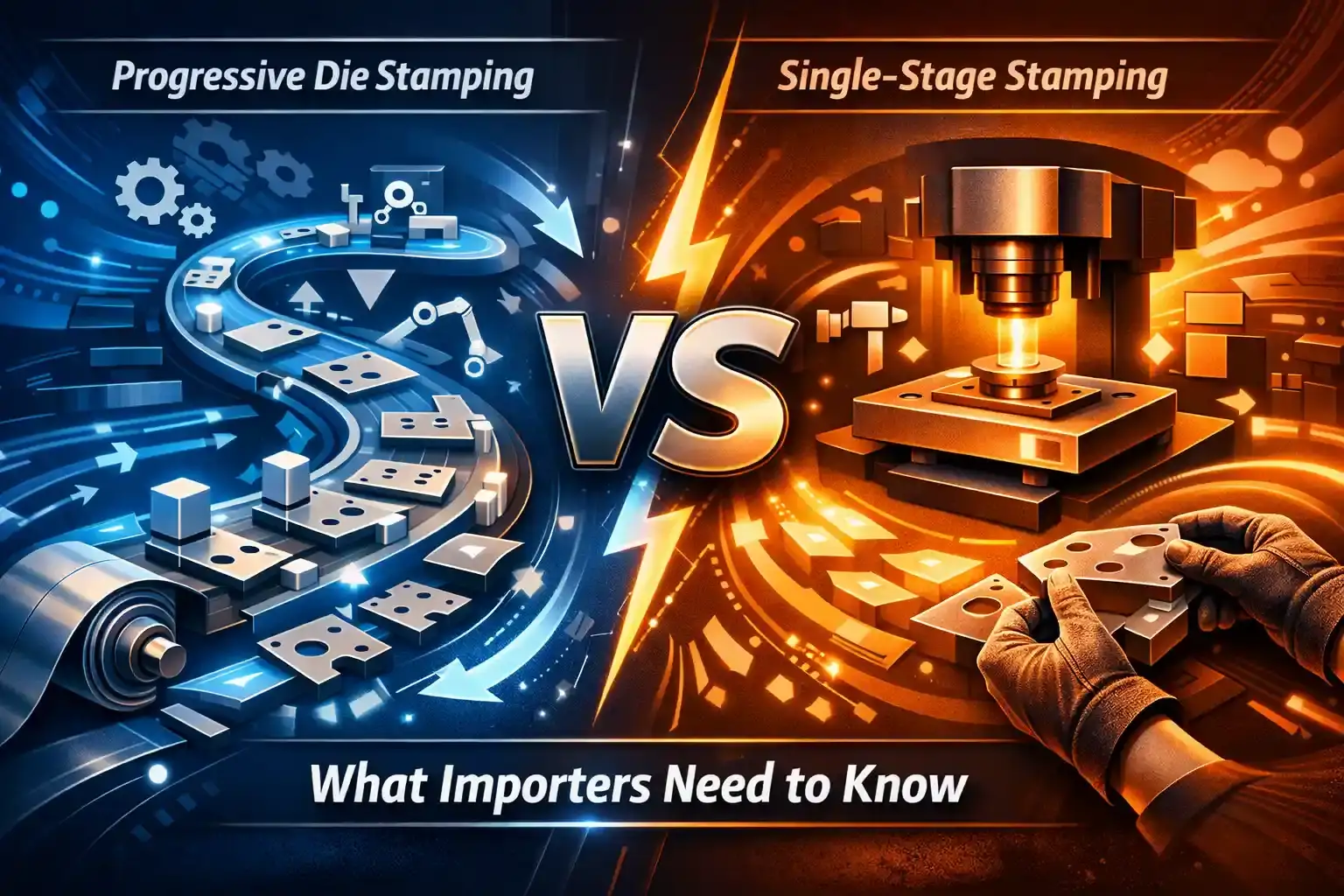
Choosing a metal stamping process is a decision that keeps procurement managers up at night, especially when you are balancing tight budgets against the relentless pressure to deliver quality parts on time. You are not just buying a die; you are effectively locking in your unit cost, lead time, and supply chain agility for the next several years.
For small to mid-sized businesses sourcing metal parts overseas, the stakes are even higher. A wrong move here means either overpaying for every single part because you chose the wrong tooling strategy, or sinking precious capital into a die that your current volume simply cannot justify. When you evaluate progressive die stamping vs. single-stage stamping, you are fundamentally deciding between higher upfront investment for long-term efficiency versus lower initial costs with higher recurring expenses.
This blog cuts through the technical jargon to give you the cost comparison progressive die vs single-stage stamping and the operational clarity you need. We will break down the real difference between progressive and single-stage stamping, so you can negotiate with suppliers from a position of strength and protect your company's bottom line.
Single-stage stamping—often referred to as line-die or engineering die stamping—is the more traditional approach. In this sheet metal stamping process, a press performs exactly one operation per stroke at a single station. To create a finished part, you might run the metal through a blanking press. After that it is shifted to a piercing press, and in the final stage it is sent through a bending station. Each step requires its own die set and the transfer of the workpiece is done automatically or manually.
Key characteristics you need to know:
Operation count: One core operation (cut, bend, punch, or emboss) per press stroke.
Feeding: Dependant upon manual loading, mechanical feeders, or robotic arms to move parts between stations.
Tooling complexity: Significantly simpler and more affordable to build.
Works Best for:
• Low-volume production of under 50,000 pieces annually.
• Simple part geometries such as brackets, flat blanks, and parts with only one or two bends.
• Prototyping: When you are still validating design and engineering specs.
• High-mix environments: Where you run multiple part variations on the same equipment.
Now, let's talk about the heavyweight champion of high-volume production. Progressive die stamping is a die stamping technique where a continuous metal coil feeds automatically through a single, comprehensive die set. This die set contains multiple "stations" that perform sequential operations—piercing, drawing, bending, coining, and final blanking—all in one press cycle. The metal strip physically carries the part through each station until the final press stroke separates the completed component.
Key characteristics:
• Multi-tasking: Performs multiple operations simultaneously in one die set.
• Automation: Coil-fed and fully automated once set up.
• Precision: The part never leaves the carrier strip, ensuring precise alignment between operations.
Works Best For:
• High-volume production requiring 50,000+ units per year.
• Complex geometries parts that require multiple shapng operations like punching, bending, and forming in sequence.
• Tight tolerance requirements that are required in automotive, electronics, and medical technology industries. Here dimension precision is a non-negotiable.
• Long production runs: Where you want to "set it and forget it."
This is the question that keeps you up at night: Where do I get the most value for my capital? The answer lies in a rigorous cost comparison progressive die vs single-stage stamping. Let's break down the hard numbers and operational factors.
|
Cost Factor |
Single-Stage Stamping |
Progressive Die Stamping |
|
Initial Tooling Investment |
Low ($5k - $15k range) |
High ($25k - $80k+, often 3x-5x higher) |
|
Per-Unit Cost |
High (slow production, high labor) |
Low (fast production, minimal handling) |
|
Tooling Lead Time |
3 - 4 weeks |
4 - 8 weeks |
|
Setup Time per Run |
Longer (must align separate dies) |
Minimal (just feed the coil) |
|
Direct Labor Costs |
Higher (human intervention) |
Lower (fully automated) |
|
Material Flexibility |
High (works with sheets or offcuts) |
Limited (requires specific coil widths) |
For a procurement professional or a manufacturing business the choice between both boils down to per unit cost. The breakeven point where a progressive die becomes cheaper than single-stage tooling usually falls between 20,000 and 50,000 parts per year, depending on part complexity. If you are ordering under 20,000 pieces annually, the low cost of a single-stage die usually makes it the undeniable winner. You simply will not produce enough parts to amortize the progressive die's higher cost.
However, if you are running over 50,000 pieces annually, the progressive die's lower per-unit cost (due to speed and automation) will rapidly overtake the single-stage economics. This is where you start saving significant money.
We know that managing cash flow for a growing business is exhausting. That is why single-stage stamping exists—to give you a low-risk entry point into production. Choose this approach when the following conditions apply:
• Annual volume is below the 50,000-piece threshold: The lower tooling cost protects your capital.
• Part geometry is relatively simple: The part can be made in one or two distinct operations.
• You need faster time-to-market: The 3-week tooling lead time helps you hit aggressive deadlines.
• Designs are still evolving: It is much cheaper to modify a single-stage die than a complex progressive tool.
• You are piloting a new product: You want to validate market demand before committing to expensive automation.
Conversely, the progressive route makes sense when you are ready to commit to a full-scale production strategy. You should consider this path when:
• Annual volume consistently exceeds 50,000 pieces: You will achieve ROI through lower piece pricing.
• Parts require multiple operations in sequence: The progressive die ensures perfect registration from piercing to bending.
• Labor costs in your sourcing country are rising: Automation reduces your exposure to wage inflation.
• Consistency is critical: You cannot afford dimensional variation between different stamping stations.
• You are planning a multi-year product lifecycle: You have the volume to justify the upfront investment.
Here is a pro-tip that many procurement managers overlook: you do not have to choose one or the other permanently. Many successful SMEs use a staged sourcing strategy. This consists of strting with a single-stage tool manufacturer to get parts quickly and cheaply for initial production or market testing. Once sales volume hits the breakeven point which can be any figure then make he shift to a progressive die for the long-term cost savings. The main advantage of this approach is that it reduces your initial financial risk while positioning you for maximum profitability down the line.
1. The Lead Time Trap
We know waiting for tooling feels painfully sloe and tedious, especially when you have a customer order on the line. Single-stage dies typically get you parts faster (3-4 weeks) because the design is simpler. However, progressive dies take longer to manufacture (4-8 weeks) since the parts geometry is complex, requiring multiple design stages. Our advice: Build a buffer into your project timeline. If you choose progressive, coordinate with your supplier early to compress the design phase.
2. The Maintenance Headache
Nobody enjoys production stoppages. With a progressive die, if one station breaks, the entire die stops. Production halts completely until that specific section is repaired. Conversely, with single-stage dies, you often have multiple presses running different operations. If the bending die needs maintenance, you can keep the blanking and piercing operations running. This operational flexibility can be a lifesaver for urgent orders.
3. Material Commitment Risk
Progressive die stamping requires sheet metal stamping in coil form, slit to a specific width. This usually forces you to buy in bulk—often measured in tons. If your demand drops, you are left holding expensive inventory. Single-stage stamping need you to buy only standard sheet sizes. This allows for more flexibility as you can buy smaller quantities and even use leftover material from other projects. For businesses that face unpredictable demand the material inventory flexibility is a massive advantage.
4. Sourcing Vendor Capabilities
Not every manufacturer has the expertise to handle progressive die projects. So, during parts procurement you need to have specific RFQ that outlines your requirements clearly. Look for suppliers who demonstrate experience with your specific material (steel, aluminum, copper) and part type. A vendor who excels at automotive body panels might not be cost-effective for a small electronic bracket. Always ask to see sample parts from similar tooling.
When you send an RFQ, do not just ask for a price—ask for a tooling strategy recommendation. A good supplier should ask you about your annual volume forecasts and part lifecycle. If they recommend a progressive die without asking about your volume, be wary. They are either inexperienced or simply trying to inflate the tooling cost.
1. "What is the estimated tooling life in strokes for this die?"
2. "How do your unit prices compare at 20k, 50k, and 100k annual volumes?"
3. "Can you provide a sample part from a similar die complexity?"
4. "What is your standard maintenance schedule for progressive versus single-stage dies?"
Choosing between progressive die stamping and single-stage stamping is ultimately a business strategy decision, not a purely technical one. For small to mid-sized businesses, the pressure is on to maximize ROI without overextending capital.
We know that managing an international supply chain is tough—from raw material volatility to shipping delays. But by aligning your stamping manufacturing approach with your volume and cash flow, you eliminate one significant variable from the equation. You stop guessing and start controlling your costs. By understanding the true cost comparison progressive die vs single-stage stamping, you can walk into the negotiation room confident that you are choosing the right process for your company's future.
If you source precision
READ FULLIf you’ve ever opened a quote for a titanium part and felt shocked to see the excessive pri
READ FULLEvery day, procurement teams across various industries like aerospace, medical devices, and indus
READ FULL

Have a question or need a quote? Fill out this form and our team will get back to you quickly!