



 +86 18368240367
 Jasonhardware@foxmail.com

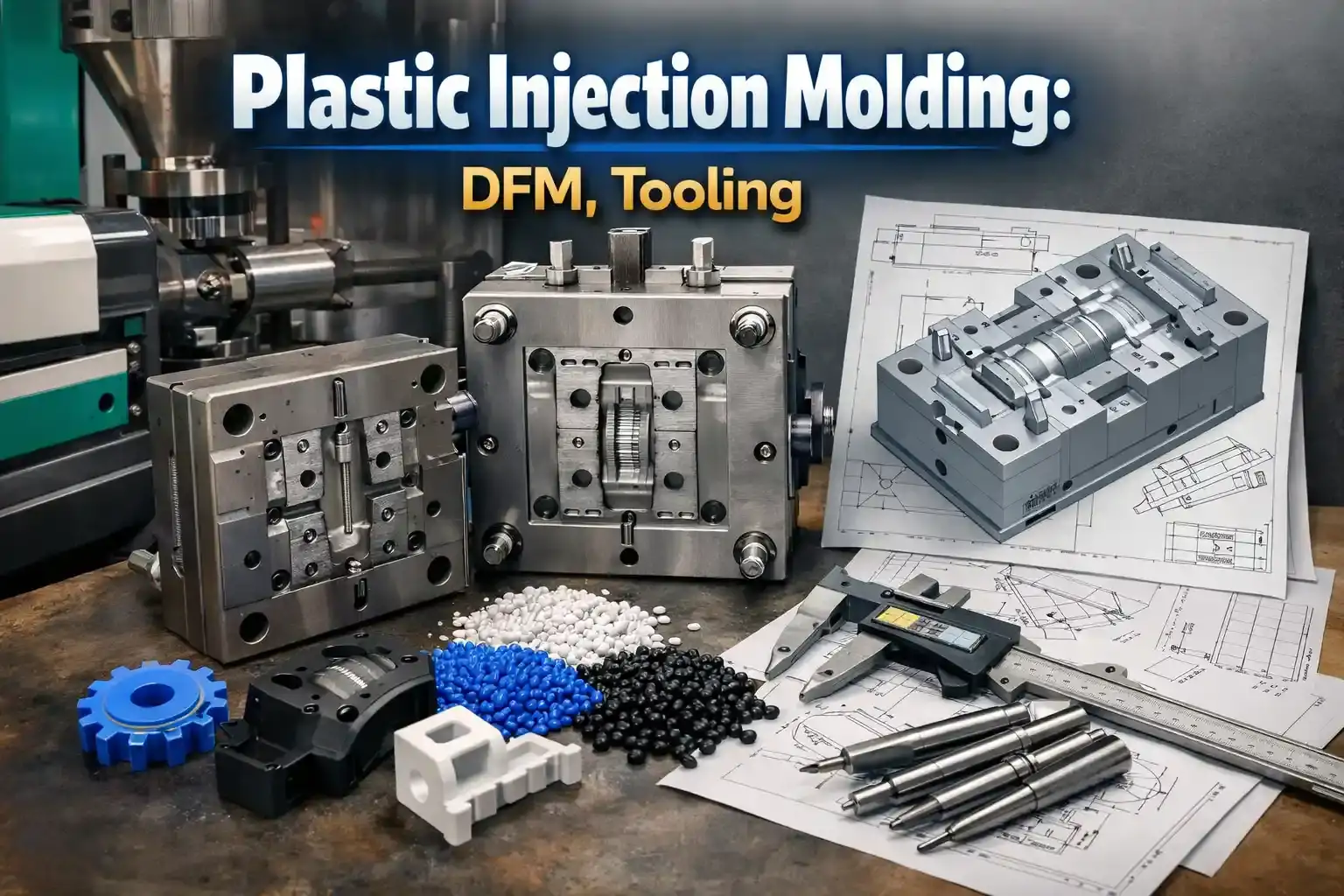
The global plastic injection molding market is projected to reach 201.47 million tons by 2031, growing at a compound annual rate of over 4%. That figure tells you about the wide adoption of this manufacturing process by industries in the manufacturing sector. Thousands of businesses, from automotive to medical devices to consumer electronics, have already discovered that plastic injection molding is the most cost-effective, scalable method for producing high-quality parts at volume.
But success doesn't start at the molding press. It starts with two things: a rigorous Design for Manufacturing (DFM) review and smart injection molding tooling decisions. Getting these right transforms injection molding from an expensive gamble into a predictable, profitable manufacturing engine.
What you'll learn in this guide why plastic injection molding works for businesses your size, how DFM injection molding saves thousands in rework costs. We will also shed light on the tooling journey and give you guidance on how to choose a partner who delivers custom plastic molding that fulfils your design vision. Let's dive in.
What Is Injection Molding?
At its core, plastic injection molding sounds simpler than its name. The process consists of molten plastic being forced under high pressure into a precision-machined metal mold. The plastic cools, solidifies into the mold shape, and is ejected as a finished part ready for assembly, and shipping.
The magic is in the repeatability. Once the injection molding tooling is built, you can produce thousands or even millions of identical parts without any design faults. That kind of precision in shaping a part is why injection molding has become the backbone of modern manufacturing.
There is another aspect also that makes injection molding exceptional which is its remarkable flexibility. The process is capable of churning a wide variety of shapes from simple bottle caps to intricate automotive components with dozens of features. If you can design it, injection molding can likely produce it.
If you're not a Fortune 500 company with unlimited R&D budgets, then you need a manufacturing process that delivers quality without breaking the bank. Here's why plastic injection molding consistently wins for businesses your size:
1. Cost Efficiency at Scale
Yes, the upfront injection molding tooling investment is significant—typically $5,000 to $100,000+ depending on complexity. But here's what the numbers actually look like:
|
Production Volume |
Per-Part Cost |
Tooling Amortized |
|
100 units |
$15.00 |
$150.00+ |
|
1,000 units |
$4.50 |
$15.00 |
|
10,000 units |
$1.80 |
$3.00 |
|
100,000 units |
$0.60 |
$0.70 |
For production runs exceeding 1,000 units, plastic injection molding becomes the most economical choice . By 10,000 units, the per-part cost is a fraction of alternative methods.
Furthermore, multi-cavity molds can produce 2, 4, or even 16 parts per cycle, multiplying your output without multiplying your labor costs .
2. Material Versatility
From ABS and polycarbonate to nylon and polypropylene, you can select materials that match your specific strength, flexibility, and appearance requirements . Need food-grade? There's a resin for that. Need the part to be flame-retardant? That exists too. Need UV-stable for outdoor use? Easily done.
This flexibility means your custom plastic molding project can be precisely tailored to your application.
3. Precision and Complexity
Plastic injection molding achieves tolerances as tight as ±0.001 inches, with complex geometries that would be impossible or prohibitively expensive with other manufacturing methods . Undercuts, threaded inserts, living hinges—all achievable with proper mold design.
4. Low Waste and Sustainability
Excess plastic from runners and sprues can be ground up and recycled, supporting sustainability goals and reducing material costs.
Despite its efficiency plastic injection molding is not perfect for every kind of business.
High Initial Tooling Cost: You're paying for precision-engineered steel or aluminum molds. This is unavoidable—but smart DFM injection molding minimizes it.
Lead Time: Injection molding tooling typically takes 4 to 10+ weeks from design approval to first samples .
Design Constraints: Features like deep undercuts or uneven wall thickness require careful planning—or they'll break your budget.
The good news? Almost all of these limitations can be managed or eliminated entirely with proper DFM. Let's talk about that next.
What Is DFM?
Design for Manufacturing (DFM) is the critical engineering review that ensures your part can actually be molded, ejected, and assembled—without defects, delays, or expensive rework .
Here's a reality check that might surprise you: About 70% of manufacturing costs are determined by design decisions . That means the choices you make before tooling begins have a major impact on your final budget and turnaround time.
Think about that for a moment. The hours you spend refining your CAD model now can save you tens of thousands of dollars in tooling revisions later. A well-executed DFM injection molding review is the single highest-ROI activity in the entire manufacturing process.
A comprehensive DFM review examines:
• Process: Is injection molding the right fit?
• Design: Geometry, features, tolerances—can this actually be molded?
• Material: Properties, shrink rates, flow characteristics
• Environment: Operating conditions the part will face
• Compliance: Industry standards and testing requirements
The goal? Simplify, optimize, and refine—so your part is manufacturable from day one .
A comprehensive DFM injection molding review examines:
• Gating design: Where resin enters the cavity
• Cooling channel layout: Thermal management for consistent quality
• Ejection system: How parts are pushed out without damage
• Mold flow simulation: Predicting fill patterns, weld lines, and stress points
When you work with a partner who provides integrated DFM + injection molding tooling + production, you eliminate handoff risks. Instead of coordinating between separate design consultants, toolmakers, and production facilities, you work with one team from concept to delivery.
That's where Renjiu Machinery excels. With advanced production equipment and strict quality control systems, Renjiu specializes in high-precision, high-stability, and cost-effective injection molded parts and automated equipment. Their comprehensive one-stop DFM solution catches potential issues before injection molding tooling begins—saving you from costly revisions and ensuring your parts are manufactured right the first time.
When you partner with Renjiu, you're not just getting a mold maker. You're getting a design partner who helps you optimize your part for manufacturability, cost, and quality—all before a single piece of steel is cut.
The Tooling Journey
Now we get to the heart of the matter: injection molding tooling itself. This is where your design becomes a physical reality—and where the greatest risks (and rewards) lie.
Phase 1: Tool Design and Planning
Once your design passes DFM injection molding review, tooling engineers create detailed CAD models of the mold. Key decisions include:
• Number of cavities: Single-cavity for low volume; multi-cavity or family molds for higher output .
• Mold material selection:
o P20: General-purpose steel with 100K shot life—good for moderate volumes
o H13: Excellent wear resistance and thermal fatigue strength.
o S136: Stainless, polishable, and corrosion-resistant and a perfect match for for optical or cosmetic parts
• Gating and runner layout: How molten plastic enters the cavity
• Cooling channel design: Critical for cycle time and part quality—poor cooling means longer cycles and higher costs
The right material choice depends on your production volume. For 10,000 parts, aluminum tools might suffice. For 1,000,000+ parts, you need hardened steel. A trustworthy custom plastic molding partner will help you match the material to your actual needs—not upsell you unnecessarily.
The actual mold is machined from steel blocks in a carefully sequenced process:
1. CNC machining: Cuts the majority of geometry—cores, cavities, and functional features .
2. EDM (Electrical Discharge Machining): Creates intricate details like sharp internal corners, deep ribs, and logos that CNC tools can't reach .
3. Assembly and fitting: Components—ejector pins, sliders, cooling lines—are installed and tested .
Precision Is Everything: A micron-scale misalignment between mold halves can result in flash, mismatch, or parts that simply don't fit together . The difference between a good tool and a great tool is often measured in thousandths of an inch.
Here's the truth that many first-time buyers don't know: No tool is perfect on the first try. The trial phase is where issues are identified and the mold is refined .
|
Trial |
Purpose |
What to Expect |
|
T0 |
Internal "dry run" of mold function |
Verify moving elements, cooling, and basic fill; no customer-facing samples yet |
|
T1 |
First customer-facing molded samples |
Full dimensional and cosmetic inspection; expect adjustments. This is where you see what's actually working—and what isn't. |
|
T2 |
Final tuning after modifications |
Production-ready parts; sign-off before mass production |
Rushing from T1 to mass production is one of the costliest mistakes you can make. Ensure color consistency, dimensional accuracy, and mechanical performance before signing off.
Let's look at the defects that plague poorly-executed plastic injection molding projects—and how DFM injection molding prevents them.
|
Defect |
Cause |
DFM Solution |
|
Flash |
Mold mismatch or excessive injection pressure |
Optimize parting line; add tapered interlocks to absorb side-loads |
|
Short Shots |
Insufficient material flow |
Review gating design and wall thickness |
|
Sink Marks |
Uneven cooling or thick sections |
Maintain uniform wall thickness; optimize cooling channels |
|
Warpage |
Differential cooling rates |
Balance cooling circuit design |
|
Burn Marks |
Trapped air compressing ("diesel effect") |
Proper venting along parting line (0.01–0.02mm depth) |
|
Weld Lines |
Split flow recombining around an obstruction |
Adjust injection temperature and pressure; modify gate location |
Each of these defects is preventable. Not with luck—with proper mold design and a comprehensive DFM injection molding review.
When you get this right, you're not just avoiding defects. You're building a reputation for quality that sets your products apart in the marketplace.
Not all custom plastic molding providers are created equal. Here's what separates the exceptional from the mediocre:
Your partner should provide actionable DFM feedback; not just a "yes/no" on manufacturability, but specific design improvements that reduce cost and risk .
Red Flag: A partner who approves everything without asking questions. That is a sign of their lack of expertise. They're either inexperienced or trying to win your business with a low quote that will rise in the future to be no longer feasible.
Green Flag: A partner who asks tough questions, suggests alternatives, and explains why certain features will cause problems.
Clear communication through T0, T1, and T2 trials. You should know exactly what adjustments are made and why .
Advanced production equipment and strict quality control ensure high-precision, high-stability parts .
Partners with experience serving Europe, America, and Southeast Asia typically maintain rigorous quality standards and understand international compliance requirements .
A partner offering comprehensive DFM + injection molding tooling + production eliminates handoff risks. Instead of coordinating between separate design consultants, toolmakers, and production facilities, you work with a single team from concept to delivery.
This integrated approach:
• Reduces communication gaps
• Prevents costly design-to-tooling mismatches
• Accelerates time-to-market
• Ensures accountability throughout the journey
Plastic injection molding is a proven, scalable manufacturing process. But just fitting the machinery in your factory will not produce the results you want. You need careful planning and the right partner also. If you have a rigorous DFM injection molding review, and a reliable injection molding tooling partner, than the possibilities are truly endless and even a small or mid-sized business can compete with the largest manufacturers in quality, and cost.
That means predictable production costs. Consistent part quality. Faster time-to-market. And the confidence to scale when demand grows. That's not just manufacturing—that's competitive advantage.
If you source precision
READ FULLIf you’ve ever opened a quote for a titanium part and felt shocked to see the excessive pri
READ FULLEvery day, procurement teams across various industries like aerospace, medical devices, and indus
READ FULL

Have a question or need a quote? Fill out this form and our team will get back to you quickly!