



 +86 18368240367
 Jasonhardware@foxmail.com

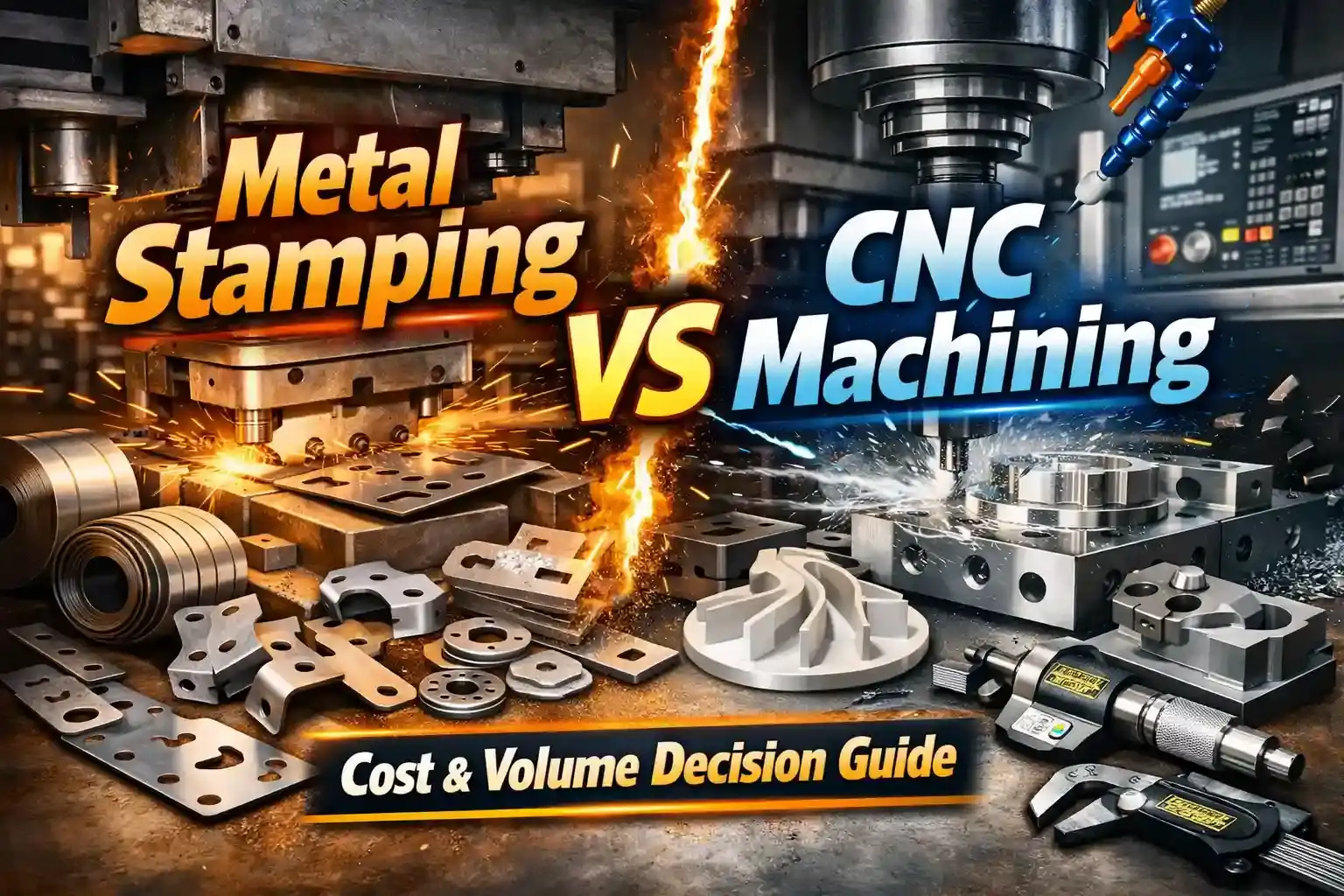
There are two common metal manufacturing methods: metal stamping and CNC machining. Both machines create good-quality metal parts. They work quite differently, however. They are ideal for a range of volumes, budgets, and part designs. Choosing the wrong process costs you money and can slow your production down! This guide explains both processes in detail, allowing you to choose a suitable option for your project.
Metal stamping is a manufacturing technique that uses a press and die to press a sheet of metal into a desired shape. The metal sheet is fed into a stamping press. The metal is cut, bent, or otherwise shaped into the desired form in one or more operations using a die set.
A stamping die is a precision-machined tool. They come at a high price, but can be produced and operate for millions of parts afterward. Metals used for stamping include all types. The procedure is quick. The number of parts can be in the hundreds or thousands per hour, depending on complexity, and the stamping press can handle that.
Many everyday parts are created using metal stamping. Some of the common stamps for bracketing, connecting, making terminals, clips, shields, encasements, and enclosures. It leads the industry in huge-volume manufacturing, in automotive, electronics, and appliances.
CNC machining involves cutting material from a metal block or bar using computer-controlled cutting tools to form the desired part shape. It's a precision machine that automates the process based on a digital design file. Mills, drills, turns, and bores material to close tolerances.
CNC Machining is considered a subtractive process. You have a lot of materiel to begin with and do some elimination. It works on many metals. It has very tight tolerances, down to ±0.01 mm. Complex parts, prototypes, and low to moderate volume production runs. This is the preferred material for complex designs, tight tolerances, or flexible materials.
When you have the basic difference in mind, you can select the appropriate method for handling a particular situation.
Tooling Cost
For metal stamping, dies are necessary. A cost of several thousand dollars can be for a simple die set. The cost of complex progressive dies can be in the tens of thousands of dollars. The initial investment is the biggest obstacle to stamping at low volumes.
CNC machining requires no special tooling beyond standard cutting tools. Businesses are charged rental fees for materials and time used on the machine. This renders CNC much more accessible for small amounts and single pieces.
Per-Unit Cost
Once the dies are made, stamping becomes very cheap per part. The press is now rapid, and parts are manufactured continuously. When running at high volume, tooling costs are spread across thousands or millions of parts, so the cost per part is very low.
The per-part cost of CNC machining is roughly the same. Similarly, there is no volume benefit. For much larger quantities, CNC will be costlier per piece than stamping.
Production Speed
Stamping is fast. A press can manufacture components in less than a second. It's a big speed difference if it's a high-volume run.
CNC machining makes one part at a time. While slower per part, no pre-programming is required other than the adaptation. Small quantities, in fact, are even quicker to process than CNC, because no die needs to be made before production.
Part Complexity
CNC machining suits the needs of intricate 3-D shapes. Deep pockets, internal features, undercuts, and threaded holes are possible. With the correct setups, the cutting tool can access most surfaces of a part.
The best shapes to stamp are simple or flat. Can do embossed, holes, and bends, but has difficulty forming high complexity internal 3D structures. Some parts are highly complex and may require multiple stampings or secondary processing.
Prototyping is clearly the domain of CNC machining. No tooling investment is needed. Within days, you can also have a physical metal part in your hand. The design changes through modifications to the digital design. Financial penalty is not applied for iteration.
Prototyping in metal is possible, but it requires soft tooling or 3D-printed inserts. These are significantly faster and less expensive than production dies, but still require more time and cost than CNC. In most prototyping applications, CNC is a faster and more flexible alternative.
When the quantity of metal-stamped parts is large, and the design is solid, it is the best time to make it the right solution. The break-even point for CNC and stamping ranges from 1,000 to 10,000 parts, depending on the die cost and part complexity.
Stamping is cost-competitive, especially if you need hundreds of thousands or millions of the same parts. The economics are quite clear at these volumes, which is why automotive manufacturers stamp billions of parts per year.
Stamping is for particular uses with sheet metal. Materials that begin as flat sheets are obvious choices for stamping, such as brackets, chassis pieces, electrical connectors, and enclosures. When a thick piece of material is cut to create a thinner piece of part, it consumes valuable machine time and materials.
Once a stamping die has been created and qualified, all stampings will be nearly identical to the first one. This repeatability is important where consistency across millions of car parts or consumer electronics is required.
Yes, frequently. Both processes may be used in the same production process. CNC machining is commonly used to produce the dies used in metal stamping. It is also used to provide secondary features on stamped components, such as precise bores, threaded holes, and machined surfaces, which are produced during the stamping process.
Some manufacturers use CNC machines to produce initial small-run parts while stamping dies are being manufactured. This enables production to start sooner than the production tools are manufactured. It is a low-risk strategy for products in the marketplace over a very short time period.
Both operations can process a variety of metals; they vary in strength. CNC machining can be done on almost any metal, including exotic materials such as titanium, Inconel, and hardened steels. It applies to thicker cross-sections as well as solid bar stock.
Metal stamping is most suitable for metals with high stamping performance. The thickness of the material is also important. Typically, sheet gauges of 0.5mm to 6mm are optimized for stamping.
Consider a couple of simple questions. How many parts do you need? If the quantity is under a thousand, CNC is invariably the most economical choice. Do you have your design complete? Otherwise, CNC will allow you to be flexible. Does your part consist of a thin sheet metal part? The obvious solution is to stamp and look for a complex inner configuration? The CNC ones do better on that. What is the time frame? There is no lead time with CNC, and it begins faster.
Stamping offers a cost and time advantage for the high-volume production of a final sheet-metal design over extended periods. CNC machining is the better option for prototyping, less complex parts, low volumes, and specialty materials. Both are used in many successful manufacturing operations, depending on the type of part and the stage of production.
Both metal stamping and CNC machining are good processes. There is no one right or wrong answer for this. It is up to your needs and wants, budget, design complexity, and time. Be familiar with the processes, know which questions to ask in each, and be able to match processes to projects. If you get that right, you will save a lot of time and money throughout your entire production program.
1- What is the method to purchase the metal stamping parts or CNC Parts in Wholesale at an economical Price?
Buy directly from the manufacturer to get factory pricing for large quantities of products.
2- How to find a Metal Stamping or CNC Machining Supplier who provides customization?
Chinese and Taiwanese metal stamping and CNC part makers offer customers the option to customize features such as geometry, materials, surface finishes, and even a private label for OEM or private company buyers. Platforms such as Alibaba and manufacturing trade shows are good places to begin verifying suppliers with customization experience.
3- Where Should I Buy Metal Stamping or CNC-Machined Parts in Bulk for a Retail Business?
Purchase directly from Chinese, Taiwanese, or Korean manufacturers via B2B suppliers such as Alibaba, Global Sources, or Made-in-China.
If you source precision
READ FULLIf you’ve ever opened a quote for a titanium part and felt shocked to see the excessive pri
READ FULLEvery day, procurement teams across various industries like aerospace, medical devices, and indus
READ FULL

Have a question or need a quote? Fill out this form and our team will get back to you quickly!