



 +86 18368240367
 Jasonhardware@foxmail.com

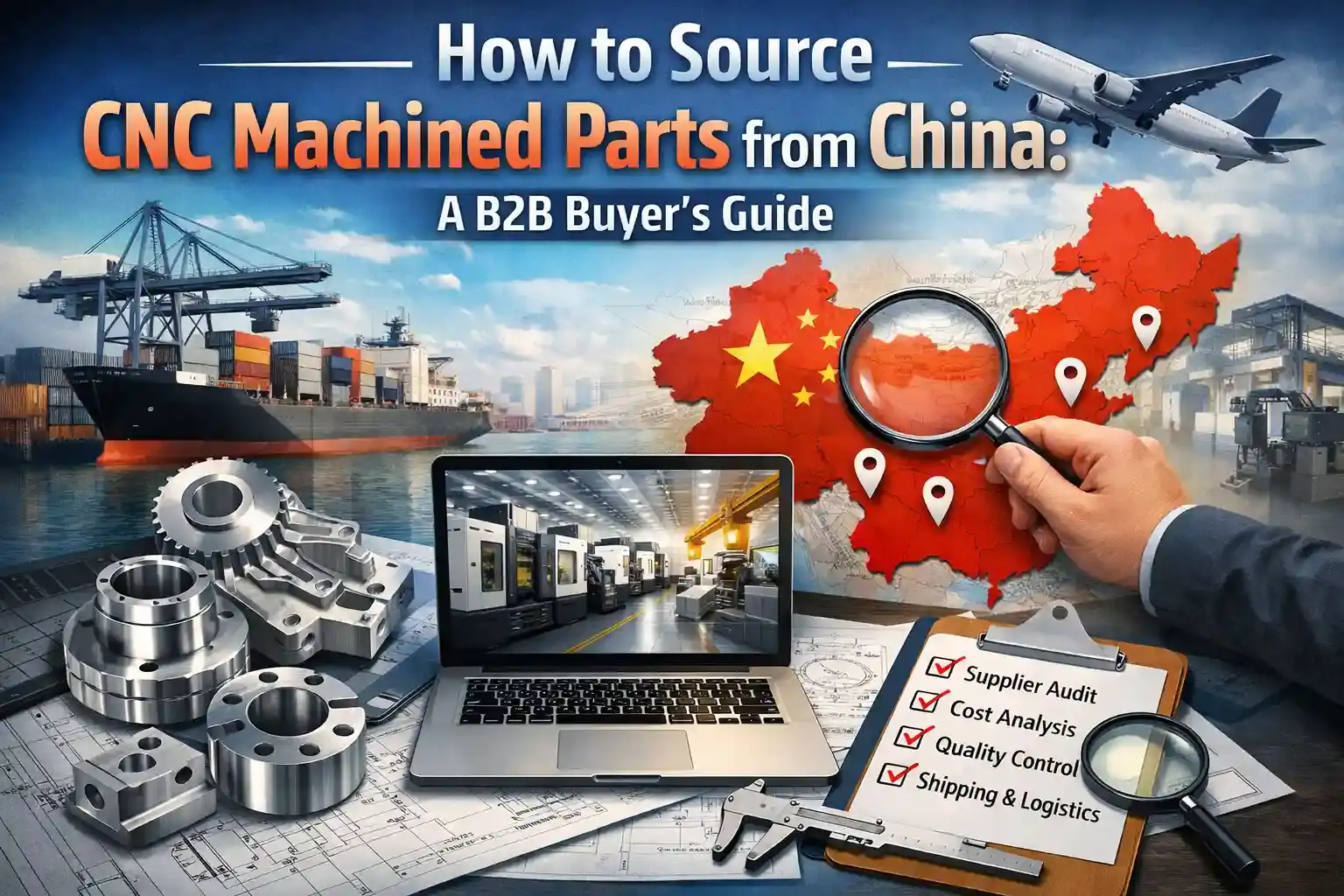
Sourcing CNC parts from China can feel like balancing a lot of things at once. You have cost pressures from your finance team. You have quality demands from your engineering department. And you have delivery deadlines that your operations people treat as absolute. These tensions are real. They keep procurement professionals awake at night.
The market data tells us why China remains compelling despite these anxieties. China's machine tool industry generated 219.78 billion yuan in production value in 2025. Exports climbed to US$9.68 billion. That upward trend represents approx. 18% increase year over year. The United States alone imports roughly US$3.45 billion in metalworking machine parts annually, with China ranking among the top global suppliers.
The numbers show a clear picture about the benefits of sourcing from China. You can achieve 20 to 35% cost savings compared to Western manufacturers. Production lead times typically run 7 to 25 days. Shipping to North America or Europe adds another 7 to 12 days. Those numbers are attractive. But what matters moe than all this is getting parts that meet the tolerances and getting a reliable flow of parts even when problems arise.
This guide gives you a compact, actionable framework. We will cover supplier vetting, technical specifications, certifications, quality control, and shipping logistics. The goal is not theoretical knowledge. The goal is a process you can implement immediately.
You cannot evaluate a supplier properly if you start in the wrong places. B2B platforms are useful, but you need precise search terms. Use phrases like "China CNC Machining," "Precision Machining Service," or "Aerospace CNC Machining." These keywords filter out general trading companies that simply subcontract work to unknown shops. LinkedIn is surprisingly effective as well. Review the profiles of engineering managers and sales directors at shortlisted firms. Serious manufacturers tend to have visible technical leadership.
Once you identify candidates, apply a structured evaluation framework. We have condensed best practices into 7 crucial criteria.
Certifications
Make sure to demand certification proof like ISO 9001, AS9100, IATF 16949, or ISO 13485 certificates depending on your industry. But do not accept the prrof given by just the supplier only. Cross check the certificate directly with the issuing body. That can be SGS, TUV SUD, or Bureau Veritas. A legitimate certificate will show the site address, the certified scope, and an expiry date within the last 12 months. Vague issuing bodies or missing renewal dates are immediate concerns.
Equipment capability comes next. You need to know exactly what machines the parts manufacturer operates. A reputable supplier will name specific equipment, such as "five-axis DMG Mori machining centers with 800mm travel." They will also describe their fixturing approach for your part geometry. Beware of any supplier who says "we can do everything" without supporting specifics. That response usually means they lack specialization or they will outsource certain manufacturing activities to a third party.
Intellectual property protection is non-negotiable. Do not share drawings before a Non-Disclosure Agreement is signed. Established manufacturers with overseas experience will have a standard NDA process. They should also describe file access controls and restricted employee permissions. Persistent resistance to signing an NDA before file exchange should disqualify them immediately.
Lead times must be quoted from the current production queue, not from marketing brochures. A transparent supplier will tell you about their current workload and any minimum order quantity requirements. They will also explain how their schedule fits with your needed delivery date.
Non-conformance procedures are surprisingly revealing. Ask directly: "What happens if a batch fails inspection?" A professional supplier will have a written recovery policy with defined timescales and clear cost allocation for rework or replacement. If the response is "this won't happen," treat that as a red flag. Problems always happen eventually. The question is whether the supplier has a plan.
Virtual verification has become the modern factory audit. Request a live video tour using Zoom or Teams. Walk through their shop floor, QC lab, and packaging area. Also request their on-time delivery rate, which should exceed 98 percent, and their typical response time. Sub-two-hour response windows suggest dedicated account support.
Your Request for Quotation is the single most important document in this entire process. A complete RFQ eliminates any vagueness regarding order details and clears up any confusion leaving no room for misconceptions or wrong assumptions. Having a complete RFQ also means you will get consistent and accurate quotes from multiple suppliers giving you a good idea.
A complete and comprehensive RFQ should include 2D PDF drawings with Geometric Dimensioning and Tolerancing. Next, provide a 3D CAD model in STEP or IGS format. Material specification should be stated clearly and exactly such as Aluminum 6061-T6 or Stainless Steel 316L. Describe your surface finish requirements by standard, for example Type II Anodizing per MIL-A-8625. State your quantity and desired delivery timeline explicitly.
The result of an accurate RFQ means that you will get a quick answer from top-tier suppliers. That means an analysis within 24 to 48 hours. In their analysis the suppliers usually suggest cost-saving design tweaks or identify features that could cause production issues. Treat this as a value-add service.
Regarding tolerances, understand the difference between what a shop achieves on a showcase part and what they hold consistently across production. Ask for Cpk data on parts with geometry similar to yours. The best suppliers will cite ±0.005mm as routine capability for critical features.
Your parts passed QC. The supplier packaged them. Now they need to cross an ocean or a continent. This is where many sourcing projects fall apart.
Ensuring that the parts reach according to your production schedule and in one piece means choosing your shipping mode carefully. Air freight through DHL, FedEx, or UPS works for small batches and prototypes. Air consolidation serves medium volumes. Ocean freight is cost-effective for high-volume, non-urgent orders, but expect 25 to 35 days transit time.
Incoterms
These determine who bears risk and cost at each stage. DDP, or Delivered Duty Paid, is often the best choice for US and EU buyers. In these the supplier handles export formalities, international freight, and importantly pays import duties and taxes. Your part arrives at your door with no surprises. DAP, or Delivered at Place, means you handle customs clearance. Have your tax ID or EORI number ready if you choose this option.
Packaging
Packaging standards cannot be left to chance. Your purchase order should include explicit language. Here is an example we recommend. "All parts must be cleaned and individually sealed in VCI anti-rust paper or plastic bags. Precision surfaces must be protected with edge guards. Parts must be immobilized within double-walled cardboard boxes using custom foam inserts. The exterior must be clearly marked 'Fragile' and 'Handle with Care.'"
Before shipment, mandate photos and videos of the packaged parts. This is your final quality gate. Also require the FAI report for all critical features before the cargo leaves the factory.
Cross-border sourcing succeeds or fails based on communication quality. The time zone difference works against you. But you can structure around it.
To simplify communication all communication should be managed by single individual from your side. On the supplier side also the contact prson should be one individual. In China the common and accepted mode of communication is WeChat which is the equivalent of Whatsapp in China. This medium is excellent for quick clarifications during the business hours. For formal approvals and documentation, use email. This creates a clear audit trail.
Your responsiveness matters enormously. Suppliers will have questions during DFM or production. A delayed answer can set the project back by a full day. Review DFM reports quickly. Treat each supplier as a potential long-term partner rather than a transactional vendor.
Start with a trial order. Even single-piece samples are accepted by most suppliers. Evaluate four to six suppliers to benchmark market rates and capabilities. Then build relationships with two or three reliable partners.
Let us summarize what matters most.
Do’s
Do verify certifications directly with issuing bodies. Do send complete RFQs with GD&T and 3D models. Do demand FAI and pre-shipment photos.
Do specify packaging in writing.
Do choose DDP for hassle-free delivery.
Do build relationships with two or three reliable partners.
Dont’s
Do not accept "we can do everything" without equipment specifics.
Do not share drawings before an NDA is signed.
Do not rely on verbal assurances about tolerances. Ask for Cpk data instead.
Do not approve shipment without FAI and packaging verification.
Watch for these red flags. Vague certification claims with no named audit body. Resistance to signing an NDA before file exchange. Lead times quoted from marketing materials rather than current queue. No written non-conformance procedure. If you see any of these, move on to another supplier.
China remains a powerhouse for CNC machining. The cost advantage is substantial. But that advantage is real only when you apply structured vetting, precise technical communication, and rigorous logistics control. Verify every claim with evidence. Treat each supplier as a potential partner. This approach consistently delivers quality parts on time, at the promised price.
If you source precision
READ FULLIf you’ve ever opened a quote for a titanium part and felt shocked to see the excessive pri
READ FULLEvery day, procurement teams across various industries like aerospace, medical devices, and indus
READ FULL

Have a question or need a quote? Fill out this form and our team will get back to you quickly!