



 +86 18368240367
 Jasonhardware@foxmail.com

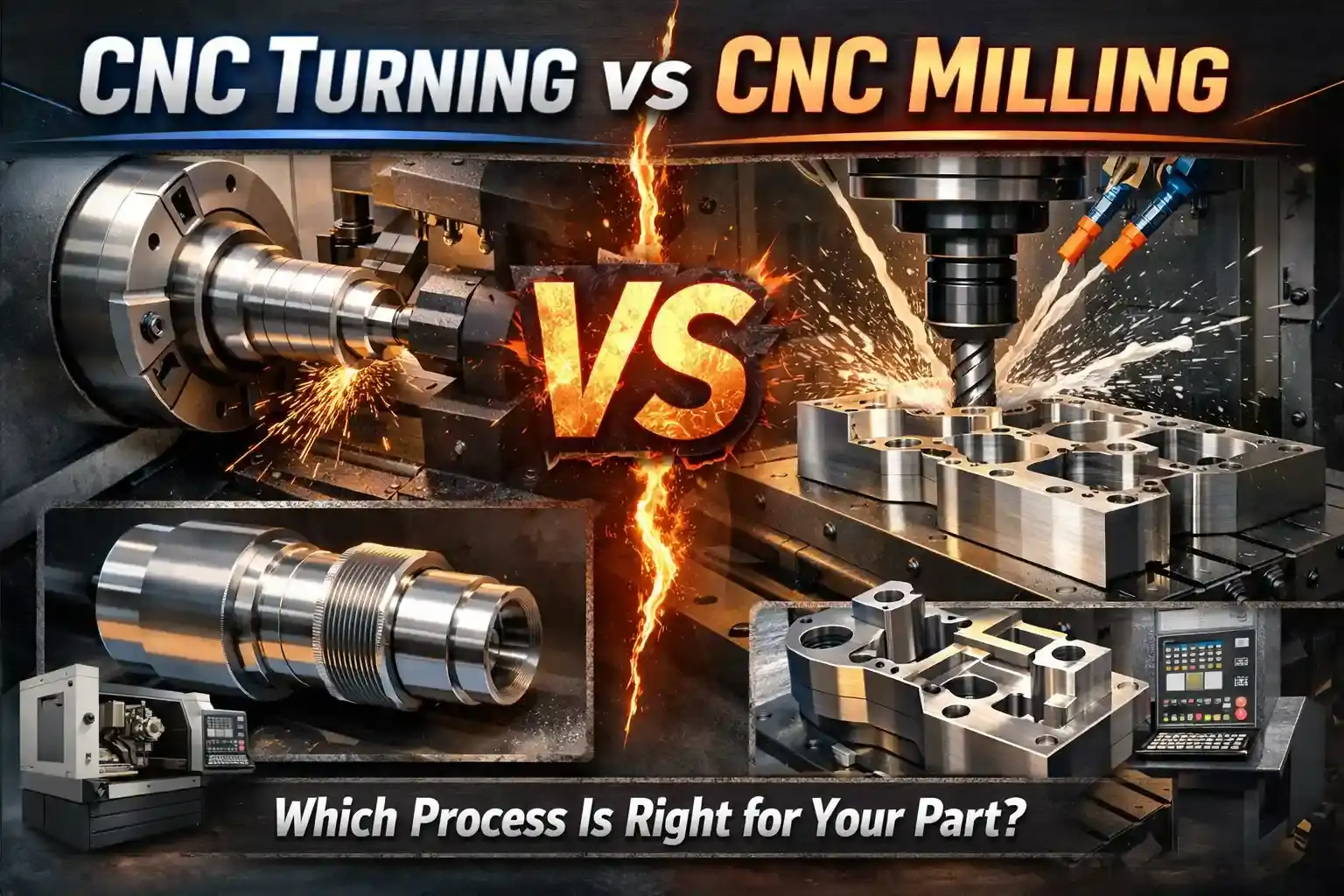
Sourcing CNC parts at scale is not a simple task. You are balancing cost per unit, lead times, material requirements, and geometric tolerances, often across dozens of part numbers at once. And before any of that, there is one foundational question that shapes everything downstream: which machining process is right for your part?
Get it right, and your production line runs smoothly. Get it wrong, and you are dealing with rework costs, scrapped batches, and supplier conversations you did not plan for.
This guide breaks it down clearly. No overcomplicated technical jargon. Just the information you need to make a confident, well-informed sourcing decision.
CNC turning spins the workpiece at high RPM while a stationary single-point tool removes material. The result is a part that is symmetrical around a central axis. Think shafts, rods, bushings, threaded connectors, and fasteners.
CNC turning is a cost-effective and efficient method most effective when creating cylindrical and round parts designed by computer-aided manufacturing (CAM) software. If your part drawing shows a consistent diameter and a defined length, turning is almost certainly your process.
The repeatability at scale is one of turning's biggest advantages. CNC turning works with programmed instructions to ensure higher production efficiency and reduce human error. For bulk buyers ordering thousands of identical cylindrical components, that consistency directly protects your quality standards across every batch.
Threading and fine bearing seats are where turning typically outperforms milling in form accuracy. A number of physical parameters like roundness, cylindricity, and functional concentricity, are achieved much more easily using turning. These are not minor advantages. In industries like automotive and industrial machinery, those tolerances are often the difference between a part that performs and one that fails in the field.
CNC turning also has a cost advantage over CNC milling when production is limited to cylindrical shaped parts. CNC turning is a highly efficient machining process for cylindrical parts, yields excellent surface finishes, and can offer increased throughput at lower production costs for some projects.
In CNC milling, the workpiece is kept in a fixed position, and the rotating shapes the workpiece through cutting away the material. Unlike turning which specializes in forging round profiles, milling does the opposite and excels at flat faces, complex contours, pockets, slots, housings, and structural frames.
CNC milling is the preferred option for manufacturing complex geometries, deep grooves, and three-dimensional surfaces. If your project requires the removal of large amounts of material from a solid block, or if you need precise control over the internal and external shape of a part, CNC milling is the way to go.
Multi-axis capability expands the possibilities of shaping the workpiece. With 5-axis milling, machinists can approach the workpiece from virtually any angle. This trasnlated to less need of additional setups and better accuracy which results in a highly finished part. For bulk parts buyers sourcing complex components like mounting brackets, enclosures, or structural frames, that multi-directional access means fewer finishing operations needed and a faster turnaround per order.
You can mill different materials, which include composites, plastics, and metals, making it a versatile solution for manufacturing. That versatility matters when you are sourcing across different product lines and need a single capable process for a wide range of part types.
Industries such as aerospace and medical manufacturing frequently rely on CNC milling for structural brackets, housings, and intricate components. If your parts fall into these categories, milling is almost certainly the right decision.
|
Factor |
CNC Turning |
CNC Milling |
|
Geometry Suitability |
Best for cylindrical, round, and rotationally symmetrical parts. Shafts. Rods. Bushings. |
Best for flat surfaces, complex contours, pockets, and non-round geometry. Brackets. Housings. Frames. |
|
Tolerances and Precision |
Excels at concentricity and cylindricity on round features. Tolerances below 0.01 mm are achievable. |
Excels at controlling complex surface geometry. Multi-axis capability improves precision on intricate parts. |
|
Production Volume and Cycle Time |
Faster cycle times for simple cylindrical CNC parts. Direct tool paths. Less setup time per batch. |
Cycle time increases with geometric complexity. Multi-setup parts take longer. Volume helps but complexity sets the floor. |
|
Cost Per Part at Bulk Quantities |
Cost per part drops fast at volume. Simple geometry keeps machine time low. High-volume turning is economical. |
Cost is driven by complexity and setups. Consolidating features on fewer faces reduces time and cost at scale. |
|
Material Compatibility |
Works with metals and plastics. Most effective on materials that hold cylindrical form under cutting forces. |
Works across metals, plastics, and composites. Versatile across product lines and material types. |
|
Setup Complexity |
Low to moderate. Fewer axes. Simpler tool paths. Ideal for buyers managing tight lead times on large orders. |
Moderate to high. Complex organic curves and undercuts require 5-axis machining and longer setup times. |
|
Best For |
High-volume, rotationally symmetrical CNC metal parts and CNC machining plastic components. |
Complex, multi-featured components requiring tight geometric control across flat and contoured surfaces. |
Process selection and material selection are closely linked decisions. Getting one right without considering the other can still result in a suboptimal outcome. Here is how to think about both together.
When CNC Metal Parts are the Best Choice
Metals such as aluminum, steel, and titanium are known for their strength and durability. They are preferred for products requiring high structural integrity and load-bearing capabilities, such as automotive or aerospace parts.
Metals can handle high temperatures without warping, making them a good fit for engine parts, and tools. If your part will be exposed to mechanical stress, elevated temperatures, or heavy impact loads, metal is not just preferred. It is required.
Aluminum is the favorite for lightweight frames. Stainless steel is another metal alloy that offers corrosion resistance for outdoor or chemical use. Common CNC metal parts materials include aluminum 6061, mild steel, stainless steel 304/316, titanium, and brass. Each carries a different cost and machinability profile, and choosing the right one for your application can meaningfully affect your per-part cost on bulk runs.
When CNC Metal Parts are the Best Choice
CNC machining plastic is not a second-tier option. In many industrial and commercial applications, it is the smarter choice.
Plastics such as ABS, nylon, and PEEK are lightweight and naturally resistant to corrosion. While they do not offer the same mechanical strength as metals, they excel in applications that demand chemical resistance, low friction, or electrical insulation, including medical devices, fluid handling systems, and electronic components.
Plastics are easier to cut than metals and that naturally means less tool wear and shorter cycle times. That translates directly to cost savings, particularly on high-volume orders.
How Plastic Behaves Differently Under Machining
Plastics are more prone to dimensional variation due to their lower melting points and thermal expansion. Improper clamping or excessive heat may cause distortion. However, using appropriate feeds, fixtures, and cooling strategies can improve accuracy in machining plastic.
When you are sourcing CNC machining plastic in bulk, ask your supplier directly about their thermal management protocols. A supplier who cannot answer that question clearly is a supplier worth reconsidering.
Understanding how other industrial buyers in your sector apply these processes gives you a useful reference point.
Automotive
Automotive applications require CNC machining for engine parts, transmission, and suspension systems. These areas are designed using metals that provide the strength and reliability required in high-stress applications. Turning handles shafts and fasteners. Milling handles housings, brackets, and structural frames. Plastic is used in car interiors like dashboards to reduce weight and improve fuel efficiency while keeping production costs low.
Aerospace
The most prevalent CNC machining processes in aerospace are multi-axis CNC milling and CNC turning. Both these processes are equally important and are the gold standard in the aerospace manufacturing sector. This is because they can achieve extremely fine tolerances, excellent surface finishes, and repeatability across production. Turning is used for shafts and valve components. Milling handles structural brackets, fuselage elements, and engine housings.
Industrial Machinery
Industrial machinery applications include parts such as gears, shafts, and fittings that have to withstand heavy loads or high temperatures. CNC turning dominates for rotationally symmetrical power-transmission components. CNC milling handles enclosures, mounting plates, and frames. Both processes work across all kinds of metals: steel, stainless steel, and aluminum, depending on the specific load and operational conditions.
Medical Devices
Medical devices and lab equipment are usually constructed from inert plastics such as PEEK for biocompatibility and also because they are much easier to sterilize than metals. CNC turning is commonly used for cylindrical instrument handles and connectors. Milling handles complex housings and intricate device bodies. The material selection here is often more critical than in other sectors, and both turning and milling are regularly applied to the same product line.
Electronics
Electronics housings use ABS or polycarbonate enclosures for insulation and shock resistance. CNC milling is the most frequently utilized in tis industry. This is because most electronic enclosures have angular shapes and flat surfaces, with precisely cut holes for mounting and connections. CNC machining plastic is particularly common in this sector, where weight savings and electrical insulation are primary requirements.
You do not need to be a machinist to make a good sourcing decision here. You just need to know what kind of part you are making.
Start with geometry. Round and cylindrical? Then CNC turning is the way to go. Complex, flat, or multi-featured? CNC milling is the best. Then look at your material. Structural load and heat resistance point toward metal. Weight savings, corrosion resistance, and electrical insulation point toward plastic. Finally, match your volume to your process. Both turning and milling scale well, but the cost-per-part advantage grows faster at volume when you optimize for the right process from the start.
Partner up with a machining partner who treats your sourcing decision as a shared problem. The right process, the right material, and the right supplier are not three separate choices. They are a complete package and getting all three right is how you protect your margins and your supply chain at scale.
If you source precision
READ FULLIf you’ve ever opened a quote for a titanium part and felt shocked to see the excessive pri
READ FULLEvery day, procurement teams across various industries like aerospace, medical devices, and indus
READ FULL

Have a question or need a quote? Fill out this form and our team will get back to you quickly!