



 +86 18368240367
 Jasonhardware@foxmail.com

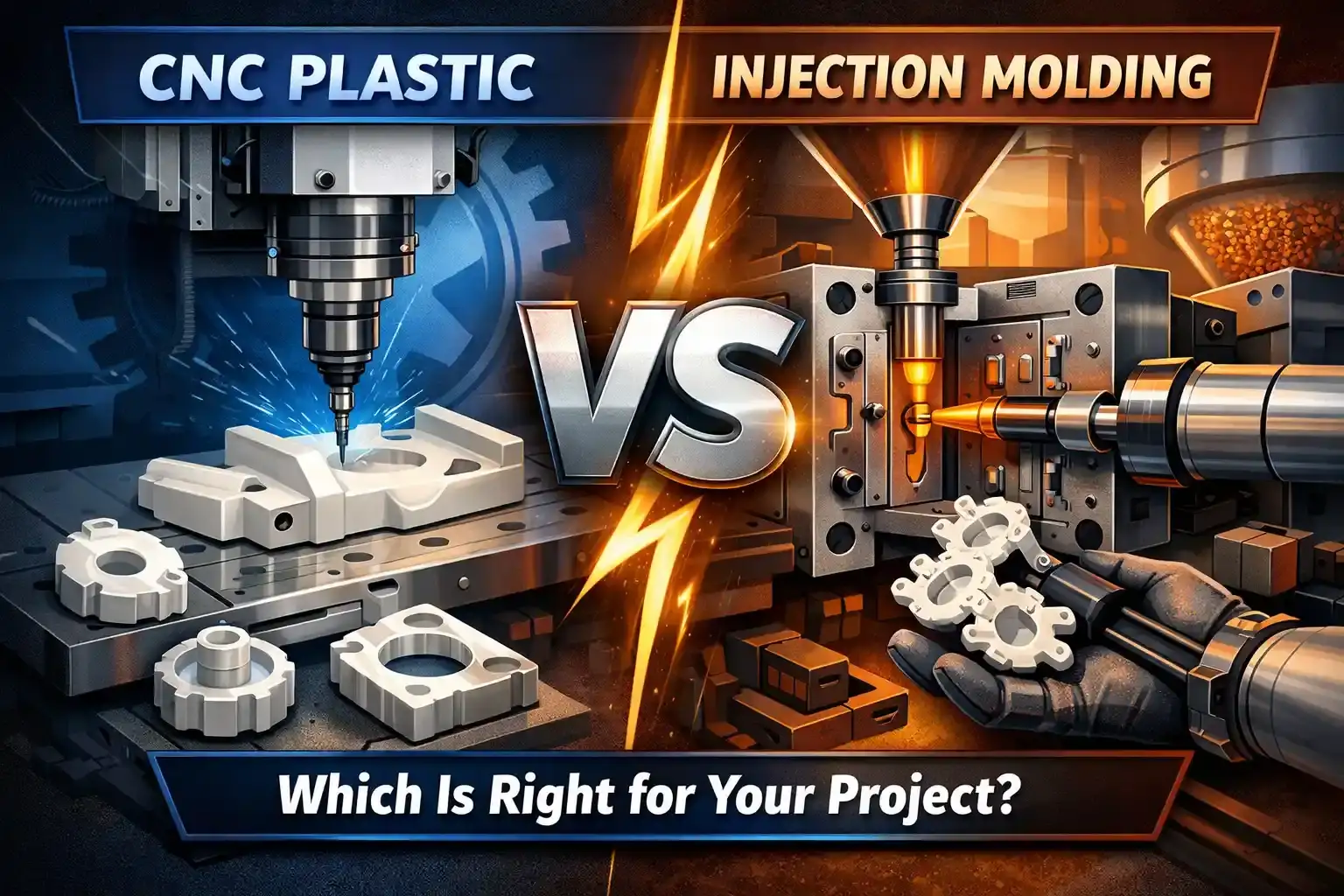
Two types of plastic part manufacturing processes arise most frequently. CNC Machines and Injection Molding. Both save high-quality plastic components. However, their work is quite different. And they work with projects of different kinds. The right choice will save you time and money. This guide can help you clearly understand the processes for choosing the right option for you.
CNC basically means Computer Numerical Control. CNC plastic machining works by using the computer to control plastic cutting tools, which cut, drill, and shape a block of solid plastic. The machine processes according to a digital design file and cuts away material until the final part shape is achieved.
It is a subtractive technique. You have the excess removed, leaving you with more materials than you require. Acrylic, nylon, PEEK, polycarbonate, and PTFE are some common plastics that are utilized for CNC machines. It will work with a variety of engineering plastic materials.
CNC manufacturing is extremely accurate. High tolerances of 0.01mm can be obtained. This is ideal for precision parts or assemblies where exact size is important.
Injection molding is an entirely different process. Plastic pellets are melted and then molded with high pressure into a metal mold. The plastic starts to flow into the mold cavity, and upon cooling, solidifies into the desired mold shape. The mold is then opened, and the part is removed.
It is an additive process in that the material is added to a pre-shaped cavity. The mold is a precision-machined steel or aluminum tool. The most costly and time-consuming aspect of the process is creating the mold. However, after the mold is made, parts are produced at high speed and at a low per-unit cost. Most plastic items in everyday use are made by injection molding. From dashboards and housings for medical devices to bottle caps. It supports very well.
To match the appropriate process to your project, it is important to recognize the underlying differences.
Tooling Cost
No special tooling is needed for CNC machining. You put your design file into the machine, and it begins working. The cost of a mold ranges from a few thousand dollars for a simple aluminum mold to tens of thousands of dollars for a complex steel mold. The largest challenge for injecting at low volumes is certainly the initial investment.
Per-Unit Cost
Things take a turn for the worse when considering per-unit cost. The cost for CNC machining is approximately the same for a single part or a thousand parts. The set-up cost for injection molding is high, but once a mold is cast, the per-unit cost is relatively low. Injection molding is much more cost-effective per part at high volumes than CNC.
Production Speed
CNC machining is more time-consuming per part. All pieces are individually machined. Once the mold has been started, parts can be manufactured in seconds. Overall, injection molding is much faster for large volumes.
Design Flexibility
The use of CNC machining continually provides designers with greater flexibility. The design can be changed by simply updating the digital file. In the injection molding process, changing the design often requires a mold change or modification. It is very costly and tiring.
For prototyping, there's no contest between the two; it's CNC machining all the way. There is no mold to make. Within days, you can have a physical part in hand. You can test it, adjust the design, and start the next test version fast. The cost of a prototype is not an obstacle for even a small startup or an individual engineer.
Injection molding prototypes do exist, although they are less popular. Prototype molds can be created quickly and at a lower cost using soft tooling or rapid tooling. These do still require more time and money, however, than CNC. In most cases, CNC is the better solution for early-stage design verification.
Once tooling costs are considered, design is complete, and your volumes are sufficient, injection molding is the answer. For each difference in part complexity and mold cost, the break-even point varies, but it's typically between 500 and 1,000 units.
High Volume Production
Injection molding is difficult to beat when you need tens of thousands of parts in a row. The smaller size costs much more per unit. It is the common manufacturing process for consumer products, packaging, and mass-market products.
Complex Geometry
Injection molding can create multi-component parts. That's when the mold retains that complexity, and every part is the same. CNC machining complex geometry is possible, but requires more time and cost per piece.
Consistent Surface Finish
Every time, an injection-molded part will be produced with the same surface finish. textures, and logos can be embedded into the mold itself. Parts machined using CNC may need extra finishing processes to get a similar surface finish.
Yes, and very often. These two processes work complementarily to one another. CNC machining is commonly used to produce molds for injection molding. It's also used to cut other features on injection-molded parts after they are removed from the mold.
In many cases, the low-volume production of a part is done with CNC machining while the injection mold is being fabricated. This enables them to begin the order fulfillment process or to finish tests before the entire tooling process is complete. The two processes complement each other, rather than compete.
Both processes can handle many plastics. However, there are some aspects of the difference to be aware of.
CNC can produce hard-to-inject plastic parts. Some rare materials, such as PEEK, are very expensive and difficult to mold, but they machine well. Thicker sections are also easier to produce with CNC, as there are no material flow or cooling-time issues.
Injection molding is used with a wider range of commodities at a lower cost. Common materials for injection molding are ABS, polypropylene, polyethylene, and nylon. Several factors must also be considered for the material used in injection molding, such as shrinkage, flow rate, and cooling behavior in the mold.
Go through a simple set of questions. What is the number of parts you'll require? If it's less than 500, then probably CNC will be better. Have you completed the design? Otherwise, you're free to handcraft something as per your imagination. How much will you allocate to set-up costs? When the initial mold cost limit is reached, begin with CNC. Are you in a hurry to get the parts? The CNC produces items with increased speed for small lot sizes. Injection molding has a faster production rate in large runs.
Injection molding is the clear winner in terms of cost and speed for mass production of a finalized design. For prototyping, small production orders, and specialty engineering plastics, CNC machining is the better option. Both are utilized in many successful product journeys. Developing and early prototyping using CNC. Scale production by injection molding.
Both processes are not always successful. The right one is dependent on the project phase, volume needs, budget, and design completeness. Understanding both helps you plan better, make smarter decisions, and avoid manufacturing the wrong parts incorrectly from the start.
What is the best location to purchase CNC plastic parts or bulk injection molded parts for a retail company?
Purchase directly from reliable manufacturers in China and Taiwan, and from platforms such as Alibaba and Made-in-China.
How much time is consumed to make a CNC Plastic or Injection Molded Part?
Small runs of CNC-machined parts usually take between five and 10 business days. First, a mold is necessary for injection molding, which may take two or four weeks of production, and then production is swift.
Are there any CNC Plastic or injection Molding Suppliers that provide bulk supply with customization at low prices?
Yes, bulk pricing is available from the factory; many Chinese manufacturers can provide complete customization, such as custom molds, geometries, brand, etc., at a competitive price.
What are the available options for purchasing CNC Plastic Parts or injection molded parts wholesale?
Dealing directly with manufacturers ensures factory pricing for both parts and saves the middlemen.
If you source precision
READ FULLIf you’ve ever opened a quote for a titanium part and felt shocked to see the excessive pri
READ FULLEvery day, procurement teams across various industries like aerospace, medical devices, and indus
READ FULL

Have a question or need a quote? Fill out this form and our team will get back to you quickly!