



 +86 18368240367
 Jasonhardware@foxmail.com

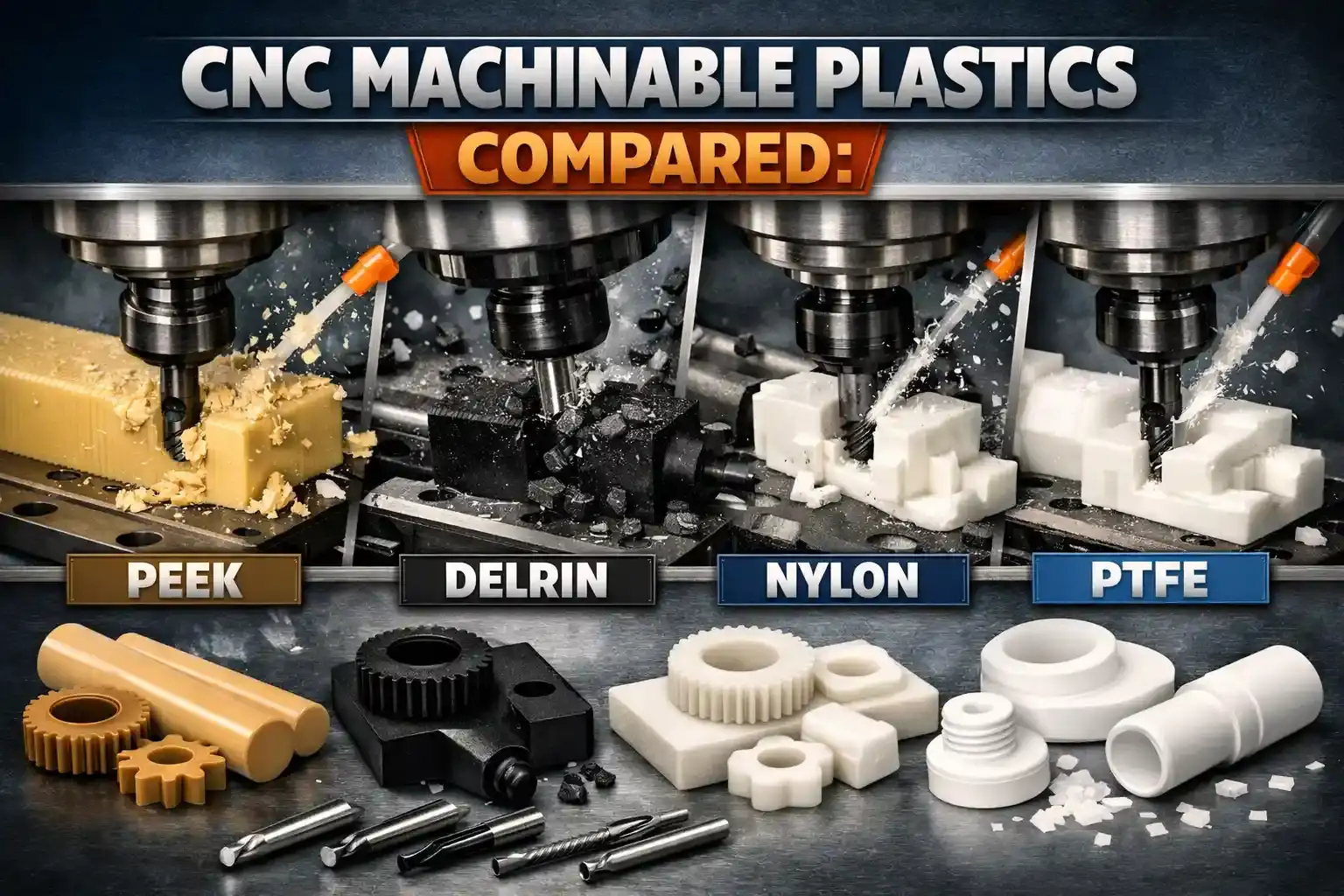
In precision parts manufacturing, quality is the single most important aspect that determines if the bulk parts are suitable for industry applications or not. If you are a parts procurement professional or an OEM manufacturer, then material selection is always a challenge.
A part that looks right on paper can fail in the field. Dimensional drift under heat. Swelling from moisture exposure. Creep under sustained load. Premature surface wear. Using the wrong material has wide-ranging negative consequences, starting from premature part failure, to expensive downtimes, and safety hazards. And when that happens in an OEM assembly or an automated production line, the cost is never just the part.
This guide is built for procurement managers, R&D teams, and product developers who need a clear, decision-ready comparison of the four most commonly specified engineering plastics for CNC machining: PEEK, Delrin (POM), Nylon (PA6/PA66), and PTFE. No unnecessary complexity. Just the information you need to make the right call.
More OEM designers are preferring plastic over metal. The reasons are practical. Plastics offer several advantages over metals. This includes lighter weight, corrosion resistance, and economical material cost. In automated equipment and precision assemblies, these properties make them highly feasible for small as well as large firms.
That said, not every plastic has the structural quality and durability that makes it suitable for high quality products. The gap between a general-purpose thermoplastic and a high performance thermoplastic for industrial use can be the difference between a component that lasts a product lifecycle and one that fails at the first stress peak. Understanding where each material sits in that performance range is what makes sourcing decisions accurate.
Quick-Reference Comparison Table
|
Property |
PEEK |
Delrin (POM) |
Nylon (PA6/66) |
PTFE |
|
Tensile Strength |
100-115 MPa |
69-80 MPa |
~80 MPa |
20-35 MPa |
|
Continuous Use Temp |
Up to 250°C |
100-110°C |
120-130°C |
Up to 260°C |
|
Moisture Absorption |
~0.1% |
~0.2% |
High |
Near Zero |
|
Chemical Resistance |
Excellent |
Moderate |
Moderate |
Exceptional |
|
Machinability Rating |
Moderate |
Excellent |
Good |
Good |
|
Relative Cost |
Highest |
Low-Moderate |
Low |
Moderate |
PEEK (Polyetheretherketone)
PEEK occupies the top rank among precision CNC plastic materials. It is a high-performance thermoplastic often used in challenging environments that require high temperature resistance, chemical resistance, and excellent mechanical properties. In the manufacturing sector, it is highly valued for its exceptional strength and dimensional stability.
The tensile strength of PEEK ranges from 100 to 115 MPa with a modulus of about 3.6 GPa. PEEK has stronger holding power under high loads. For components that will be exposed to sustained stress, the rigidity of PEEK makes it the ultimate choice for R&D teams that are designing products that deliver long service life.
If you consider thermal stability of CNC plastics, then here also PEEK stands out. PEEK is an excellent choice for applications that demand continuous service above 200°F (93°C), autoclave sterilization, or broad chemical resistance. But if you are making products that will not function in these conditions, no need to waste your budget by opting for PEEK. In medical device manufacturing specifically, PEEK is a great fit for applications requiring biocompatibility, repeated sterilization, and high mechanical stability. Medical equipment made from PEEK includes implants, surgical instruments, and precise small components such as endoscopic parts.
The tradeoff is cost. PEEK costs 7 to 20 times more than other common engineering plastics. Machining is also slower compared to Delrin, requiring tighter control over cutting parameters.
Best for: Aerospace components, medical devices, semiconductor cleanroom parts, and chemical processing equipment.
Delrin / POM (Polyoxymethylene)
If your operations revolve around tight tolerance plastic machining, then Delrin is the gold standard. Delrin (POM) is considered the most machineable engineering plastic in this category. It is clean to machine using standard tools, tolerant, and provides high-quality surface finishes.
Delrin machines cleanly and leaves a smooth, high-quality surface straight off the tool. Its rigidity helps prevent vibration, keeping it stable during precise detailing and machining. That property alone makes it highly suited for high-volume production runs where a uniform quality standard is a non-negotiable.
Regarding durability, Delrin holds its own under moisture exposure. Delrin (POM) is highly resistant to moisture, and its dimensions remain stiff and undamaged in wet and humid conditions. Such moisture resistance makes this material fantastic for precision gears, and parts that require tight tolerances.
While this plastic material has a lot of strengths it is not invincible. It is vulnerable to strong acids and oxidizing agents so factor that in early during design review.
Best for: Gears, bushings, sliding guides, valve components, automation assemblies, precision actuator parts.
Nylon (PA6 / PA66)
Nylon is the plastic material that is the most widely used in industrial sector among all plastic types. Nylon is strong, has good impact resistance, and is widely available in block or bar form.
Delrin offers high stiffness and dimensional accuracy, while Nylon provides better toughness and impact resistance. So, if your component faces repeated impact loads rather than sustained compressive stress, Nylon is likely the better fit. It is also the most cost-accessible of the four materials, which makes it a reasonable default for structural parts in non-critical environments.
Where Nylon falls short is in moisture. This is the most important limitation for OEM procurement teams to understand. Nylon absorbs a lot of moisture from the environment. This causes it to swell. The swelling leads to loss of hardness and distorts the dimensions, so precision-machining this material is an issue.
But this fault can be resolved. There is an entire category of reinforced nylon materials that are moisture resistant. Reinforced nylon also handles heat better than Delrin, especially in reinforced grades. Glass-filled Nylon 6/6 can tolerate continuous temperatures around 120 to 130°C, while standard Delrin usually caps out closer to 100 to 110°C.
Best for: Structural housings, impact-loaded gears, bearing surfaces, and weight-sensitive assemblies in controlled environments.
PTFE (Polytetrafluoroethylene)
PTFE earns its place in custom CNC machined plastic components through one defining property: the lowest coefficient of friction of any known solid material. This property makes it slippery and that slippery nature is highly suitable for making bearings and seals. When your design priority is eliminating friction or achieving near-total chemical inertness, no other plastic material can match PTFE.
PTFE is really thermal-resistant and can withstand temperatures above 200 degrees Celsius without losing its shape. For seals, gaskets, and electrical insulators that operate in chemically aggressive or high-heat environments, that combination of properties is genuinely difficult to replicate.
The structural limitation is real, however. PTFE retains zero moisture yet creeps when subjected to constant load, and this should be considered when designing. Do not specify PTFE for load-bearing structural parts. It is a sealing and insulating material first.
From a machining standpoint, a low cutting speed of around 30 to 60 m/min is advisable for PTFE. Tool wear is very insignificant in its machining. It machines without much tool stress. The challenge is workholding, as PTFE's soft and slippery nature requires careful fixturing.
Best for: Seals, gaskets, chemical-resistant liners, electrical insulators, and low-friction slide components.
Plastic material selection for OEM components does not have to be complicated. Run through these five criteria before you finalize your specification.
1. Operating Temperature
If continuous service exceeds 200°C, specify PEEK. For moderate heat environments up to 130°C, glass-filled Nylon or Delrin will serve you well. PTFE handles high heat but not under load.
2. Chemical Exposure
Aggressive solvents, acids, or repeated exposure to industrial cleaning agents? PEEK or PTFE are your choices. Standard industrial environments? Delrin performs reliably.
3. Load-Bearing Requirements
Sustained mechanical stress or high-cycle fatigue? PEEK. Moving mechanical parts under medium load? Delrin. Impact absorption as the primary function? Nylon.
4. Dimensional Tolerance
Temperature and chemical exposure are the two factors that most often force the material decision. If the part operates below 82°C in a chemically benign environment, the choice is between Delrin and Nylon based on mechanical requirements and cost. For the tightest tolerances, Delrin is the safer choice due to its minimal moisture absorption.
5. Budget When cost is a primary concern and the application environment is not extreme, Delrin offers excellent machinability and strength. However, if you need to meet high temperature, severe corrosion resistance, or medical compliance requirements, PEEK becomes the more strategic option.
The best plastic for CNC machined parts is not a universal answer. It is always the material that matches the operating environment, tolerance requirements, and cost ceiling of your specific application.
If you want quality plastic parts, having material knowledge to select the right plastic is only one part of the equation. You also need a manufacturer that understands how to work with each material at the machining level. Cutting parameters, tooling selection, and finishing protocols all vary significantly between PEEK, Delrin, Nylon, and PTFE. A manufacturer without hands-on experience across all four will not be able to deliver the tolerance level in in precision assemblies.
Ningbo Renjiu Machinery Co., Ltd. specializes in precision hardware parts processing and automated equipment manufacturing, with deep technical capability across the full range of precision CNC plastic materials. Their team has diverse expertise and can adapt to any type of project, with manufacturing expertise to deliver consistently within specification.
Each of these four materials is relevant in plastic machining. PEEK delivers unmatched performance under extreme conditions. Delrin is the gold standard for machinability and dimensional precision. Nylon brings cost-effective toughness to structural and impact-loaded applications. PTFE handles friction and chemical resistance better than anything else in this group.
The fundamental rule of plastic material selection for OEM components is straightforward. Match the material to the environment, not the other way around. Over-specifying PEEK where Delrin will perform costs you margin. Under-specifying Nylon in a wet environment costs you quality.
If you source precision
READ FULLIf you’ve ever opened a quote for a titanium part and felt shocked to see the excessive pri
READ FULLEvery day, procurement teams across various industries like aerospace, medical devices, and indus
READ FULL

Have a question or need a quote? Fill out this form and our team will get back to you quickly!